

Craft and Capital
What holds value when machines can make almost everything, from the most expensive concrete on earth, to luxury the retail arms race, the SpaceX unwind and OpenAI's leaked books.

When machines can make almost everything, the value collects in what they can’t.
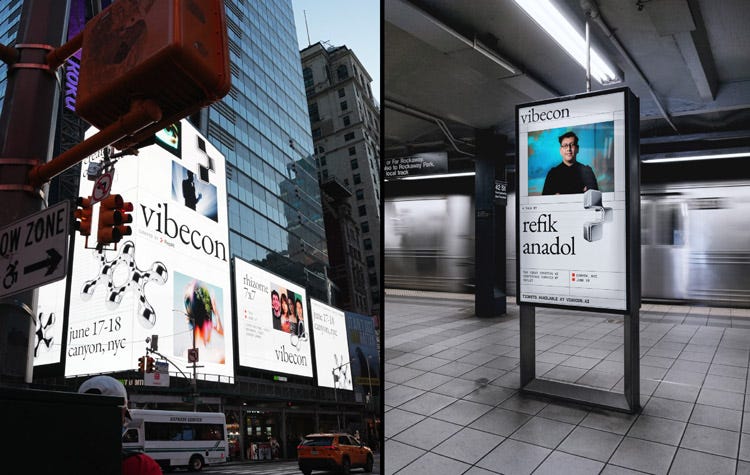
MATTE launched VIBECON in New York last week, Replit’s first creative AI conference. While there, I talked to a lot of people at the top of their creative game but early in their AI journey. What we talked about had nothing to do with the models. It was about the effort. What they wanted to discuss was the human work that goes into making something good with these tools: the iteration, the taste, the labor that machine-made validation tends to write off.
A lot of what I’m touching on this week circles around effort, time, and craft.
A self-taught architect who turned raw socialist concrete into the most expensive look in luxury real estate. Hermès opening a sixth flagship after a seventeen-year, six-building restoration, and Rolex putting a boutique on a Swiss summit you can only reach by train, two cable cars, and a revolving gondola. Mother Design opening a shop in West Adams focused on analog curation, and the case for agencies building whole product worlds.
Adjacent, SpaceX as the dust settles on its IPO. OpenAI racing its leaked financials against Anthropic toward an IPO. Aaron Sorkin returning to Facebook to move the question from how he built it to what it did to us. Peter Thiel’s private club caught ranking its guests by wealth and fame. Midjourney moving into MRI scanners. And another indie book publisher for niche design resources.
VIBECON NYC
We launched VIBECON in New York last week, Replit’s first creative AI conference. The two-day festival found a real gap, bringing the creative community to the tech through IRL demos, presentations, and conversations.
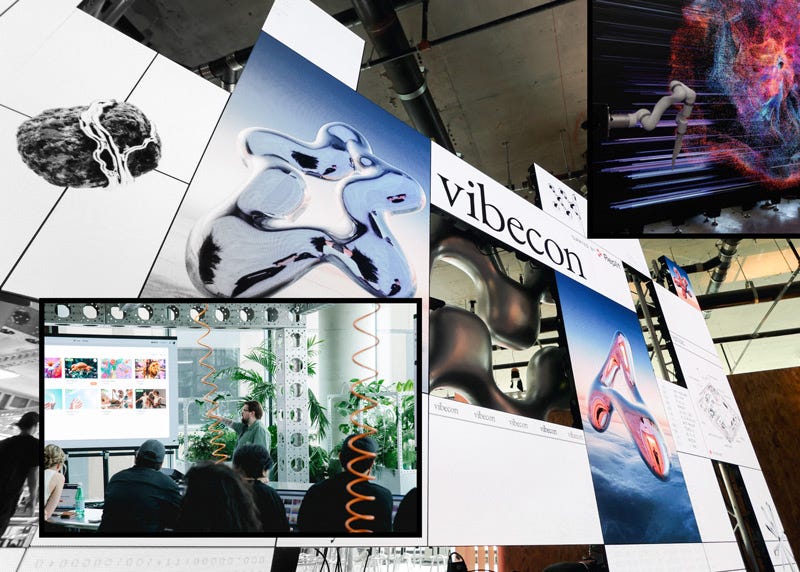
I’ve seen a ton of tech conferences around AI, but none that directly speak to creatives. Highlights were talks from Spike Jonze, Rhizome, Refik Anadol and many more, alongside bespoke installations and a closing performance from Benji B.
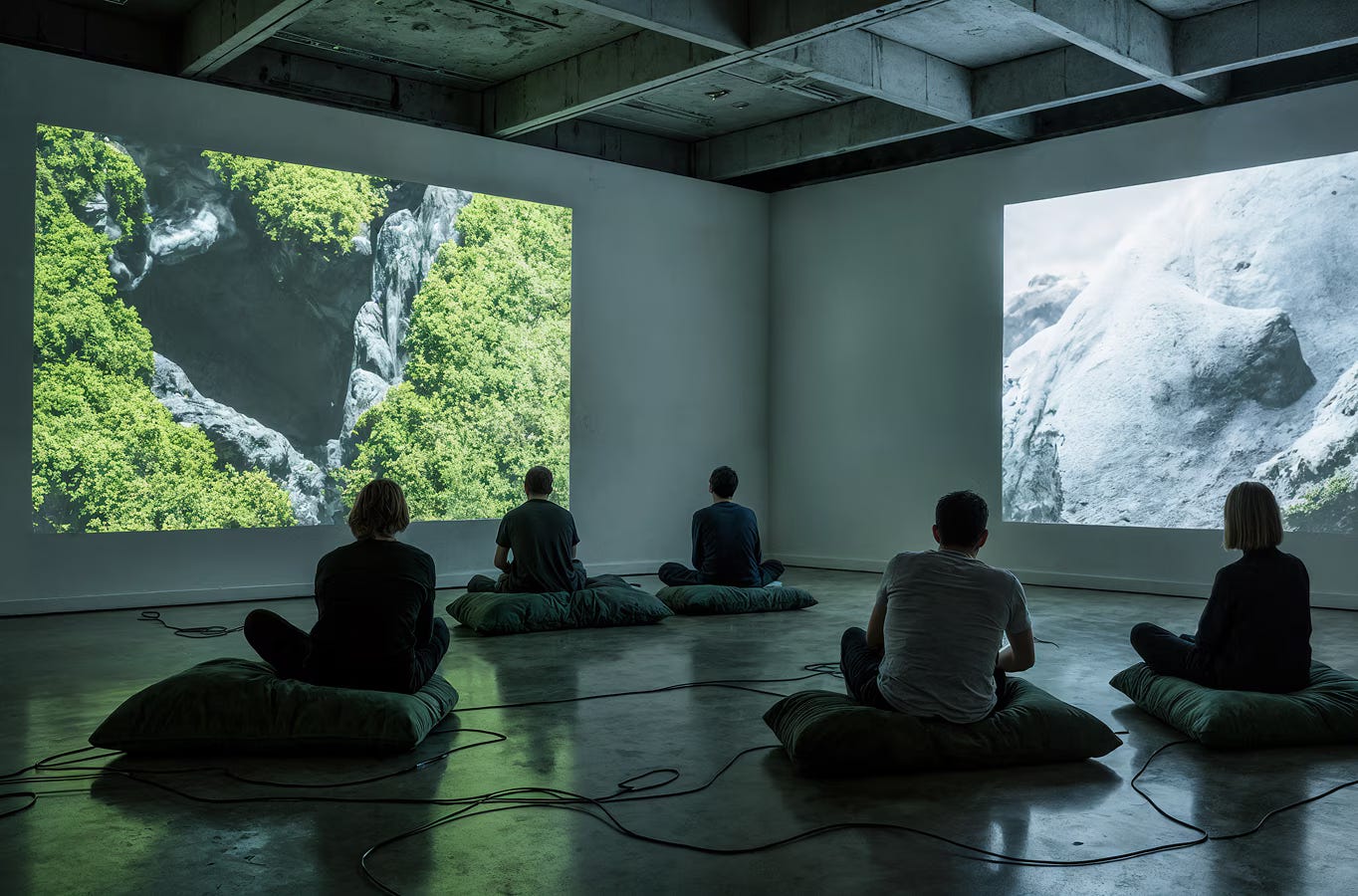
Doing it in New York instead of San Francisco was the right call, stepping outside the tech echo chamber and planting a flag in one of the densest creative cities on earth. This was one of the highest RSVP-to-invite returns of anything I’ve sent out, and we run a lot of events on the client side. People were genuinely curious what this was.
Replit raised $400M in March at a $9B valuation, triple what it was worth six months earlier. That gave them room to put real money, time, and effort into a conference adjacent to the core business, one that bridges tech and creative process. They didn’t just “throw a party.”
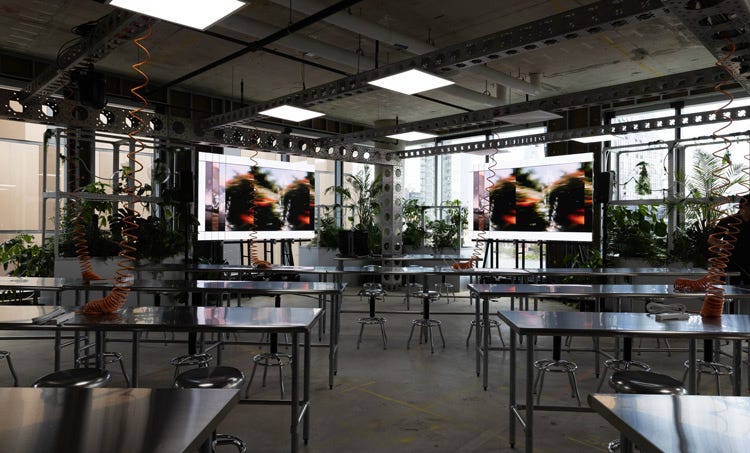
AI companies should be looking for more ways to engage like this. On opening night, most of the conversations I had were with people at the top of their game creatively but still early in their own AI journey.
The gap I see is siloed conversation. There’s a lot of discourse around AI, most of it on X, and it’s niche and circular. A lot of people aren’t on X and aren’t reading any of it. Getting that conversation off the platform and into a room that doesn’t feel dauntingly techie brings more people in.
The other gap people discount is the human effort behind AI work. Machine-made still dominates the validation, and it’s where a lot of people write off creative projects made with these tools. The iteration, taste, and labor that goes into a good output gets flattened into “made with AI.” Platforming that effort, making the work visible, is something the whole field does badly. Replit’s own co-founder called coding “the next creative frontier.” “Taste is now a product category” was a line I used back in April about manufactured music. At VIBECON it was the literal thesis of the conference.
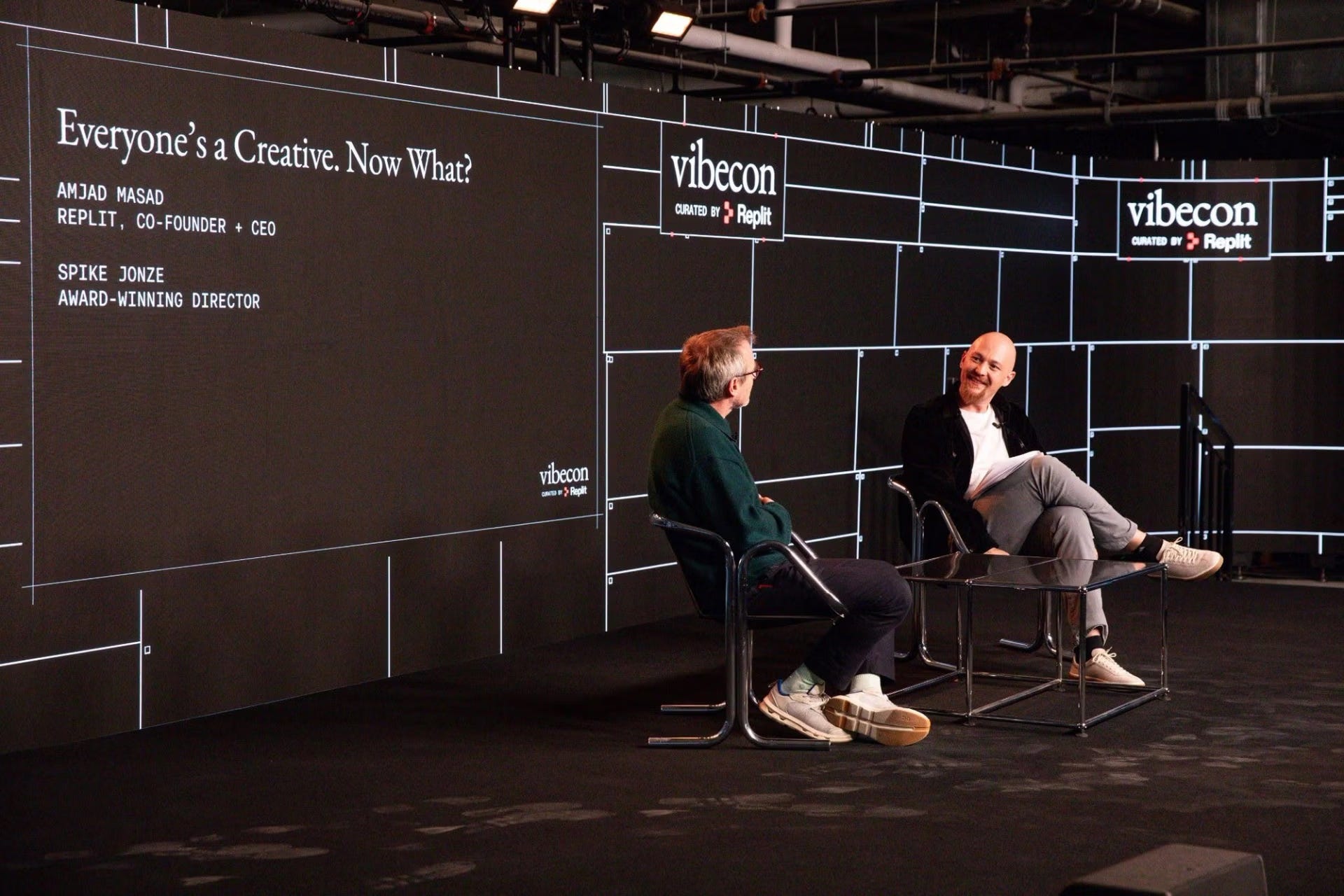
The headliner was a talk between Jonze and Replit CEO Amjad Masad, titled “Everyone’s a creative. Now what?” Jonze sits in a precarious spot. A lot of his industry is wary of anyone aligning with AI, something I touched on last week with Scorsese. He was careful, and good on where the tool empowers and where it limits. His clearest point: AI in its current form is a singular, solitary experience. You go into an AI k-hole, come out, and maybe collaborate with the output. What he wants is a tool that drives active collaboration, which he calls one of the critical parts of creative work.
On record he put it plainly: AI “shouldn’t replace human collaboration,” because “that’s where some electricity happens that can’t be defined.” Masad, from the operator’s seat, added something that stuck with me: younger people at his company ask fewer questions now, defaulting to AI instead of seeking out mentors.
My takeaway is that we’re in a sentiment moment. The big AI companies have to convince people, and only 16% of Americans think AI’s impact will be positive. The smart ones are going to engage in real rooms, platform the actual work behind the output, the challenges and the benefits, and humanize the tech.
SOCIAL RECKONING
Speaking of humanizing the tech…
Sixteen years after The Social Network, Aaron Sorkin returns to move the question from “how he built it” to “what it did to us.”
The first film, directed by David Fincher from Sorkin’s script, feels like it belongs to a different era: a psychological profile of Zuck, the lightning-in-a-bottle of Facebook’s ruthless origin and the dorm-room betrayal, cut off before the platform became a geopolitical force.
The Social Reckoning is a standalone sequel with a new cast and Sorkin directing. It’s more pointed, skipping the IPO, the metaverse, and the Cambridge Analytica years to land on the 2021 Frances Haugen leak, the “Facebook Files” that Wall Street Journal reporter Jeff Horwitz published, documenting that Facebook’s own internal research showed it knew about teen mental-health harm and chose engagement anyway.
Jeremy Strong steps into the shoes Jesse Eisenberg refused to step back into. Sorkin spent three days trying to change his mind, telling Vanity Fair, “I felt like it belonged to him, and he was certainly battle-tested.” Eisenberg “simply did not want to be conflated with Mark Zuckerberg anymore, that he has his problems with the guy.” He has been specific about those problems, objecting to Zuckerberg “taking away fact-checking and safety concerns,” and Meta did end its US fact-checking program in January 2025.
Zuckerberg is less central this time. The film turns on the decisions made behind closed doors, the ones that led to this year’s first jury verdicts holding Meta and Google liable for addictive-by-design harm, plus the $375 million New Mexico child-safety verdict I wrote about as Big Tech’s Big Tobacco moment in Intake #51.
The 2010 film gave us Zuckerberg’s “I’m CEO, bitch.”
The 2024 Senate Judiciary hearing gave us the same man turning to face the families and apologizing:
“I’m sorry for everything you have all been through. No one should go through the things that your families have suffered.”
Mark Zuckerberg, Senate Judiciary Committee hearing, January 31, 2024
STUDIO WORK
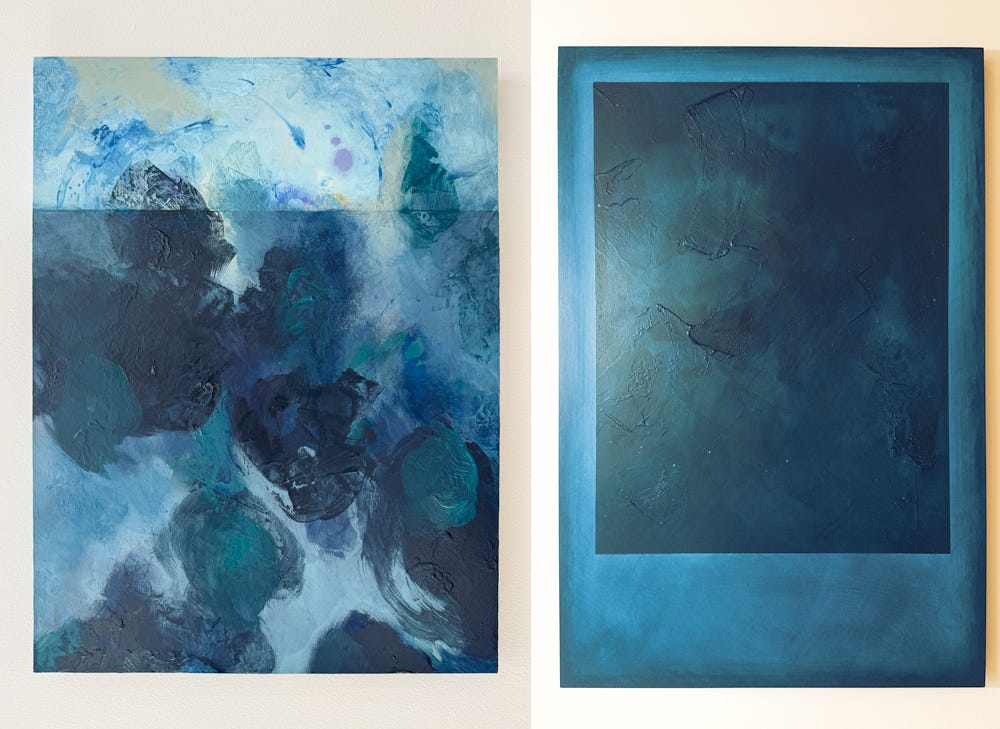
Two new pieces in blue. More of my studio practice and process HERE.
TADAO ANDO
Your Favorite Artist’s Favorite Architect.
Last week I covered Fujiko Nakaya’s Cloud exhibit, which sits inside the Tadao Ando room at Paris’s Bourse de Commerce. This week Ando is profiled in Whitewall from his Osaka atelier, his work sits in as many mood boards as James Turrell’s, one of the most referenced and coveted modern architects alive.
“Freedom emerges not from the absence of discipline, but from working within it.”
— Tadao Ando, Whitewall, June 12, 2026
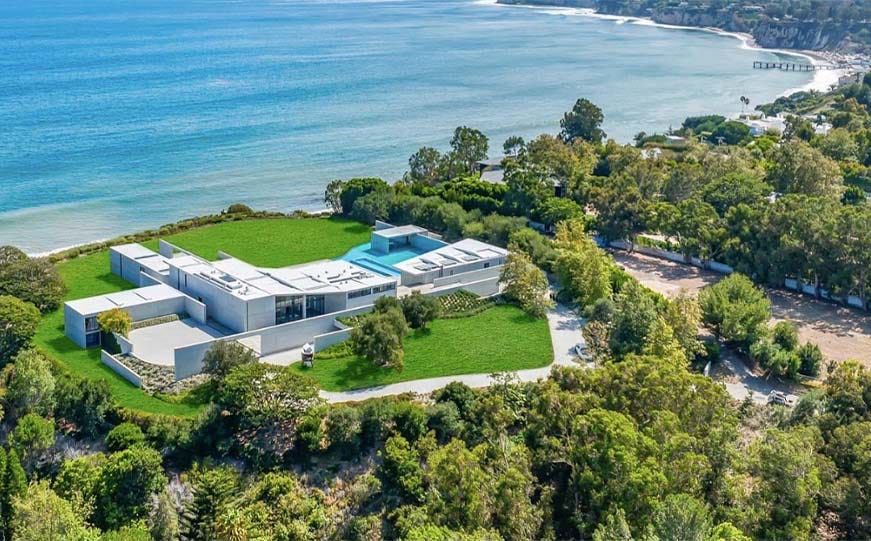
Beyoncé and Jay-Z paid roughly $200 million for his only Malibu collector’s house, a 40,000-square-foot property commissioned by art collectors Bill and Maria Bell that “doubles as an art museum.” It is the most expensive home sale in California history. Kanye bought a separate Ando down the coast for $57.3 million, gutted it to a concrete shell, and offloaded it for $21 million in 2024, a roughly $36 million loss that has since rolled through lender default and stalled foreclosure auctions into 2026. The New Yorker’s Ian Parker reported the demolition in forensic detail, one of the sharper looks into Ye’s orbit and psyche during that volatile post-DONDA era.


Tom Ford’s early Ando ranch in New Mexico is a masterpiece; he was one of the first Americans to commission an Ando home.
Ando took the material vocabulary of brutalism, a postwar and broadly socialist movement built on raw poured concrete and an anti-ornament ethic, and refined it past brutalism entirely. His surfaces are not raw: they are sealed and lacquered smooth by specialized, high-cost labor, turning the people’s material into the most expensive minimalism money can buy.
You do not have to buy one to stand in it; his work is on view in public spaces worldwide. Such as his many buildings across the Chihu Art Museum in Naoshima Kagawa, Japan, or the modern art museum in Fort Worth Texas.


Azuma House, Sumiyoshi, 1976 is where the language starts: a blind concrete box on a narrow Osaka lot whose plan forces residents across an open-air courtyard, umbrella in hand, to move between rooms.
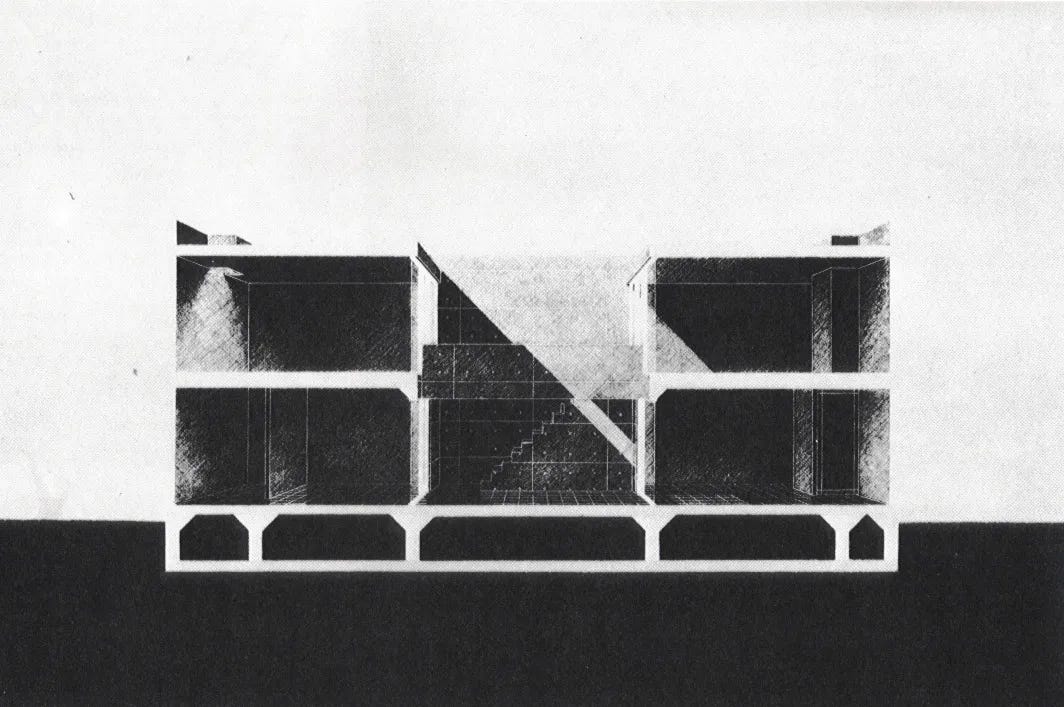
He calls it a philosophy of discomfort, and it won a Japan Association of Architecture prize that year.
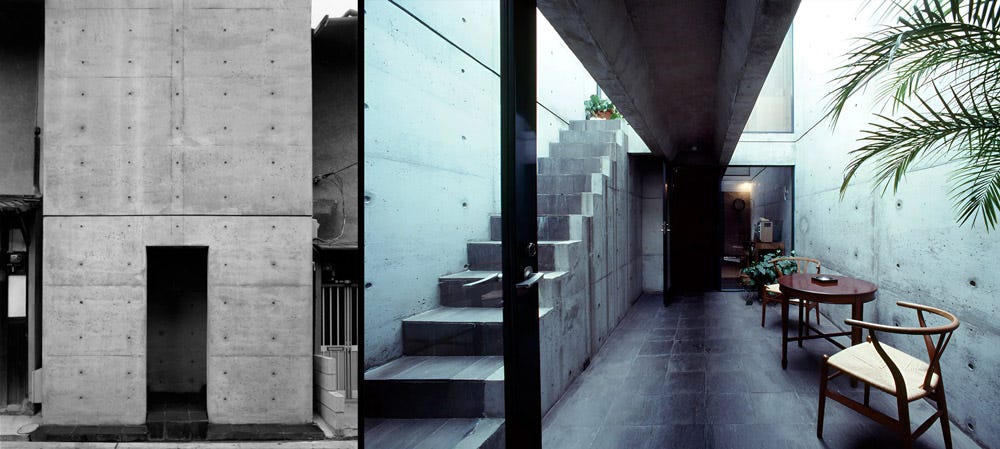
At 84 he is still prolific, having opened his tenth building for Naoshima, the Naoshima New Museum of Art, last spring. The lore holds: self-taught by reading, correspondence courses, travel, and tracing Le Corbusier’s drawings, he opened his Osaka studio in 1968 with no architecture degree and won the Pritzker in 1995.
BATT MAILLIE
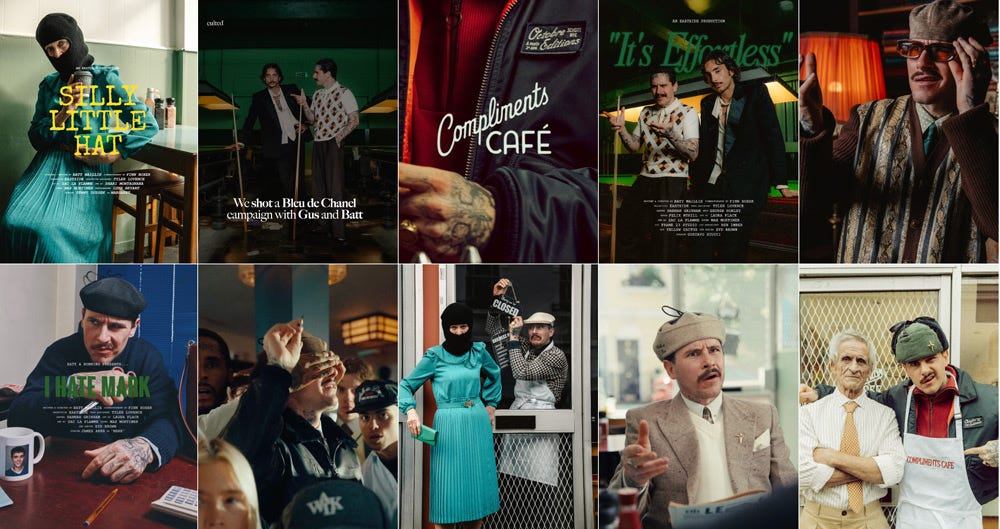
One of the best young directors to watch, the British filmmaker Batt Mallie brings aesthetic, old school cinema technique and a sharp sartorial style to his work. His shorts feel like Guy Richie films. Often in collaboration with Gustavo Stucci who stars and co-directs.
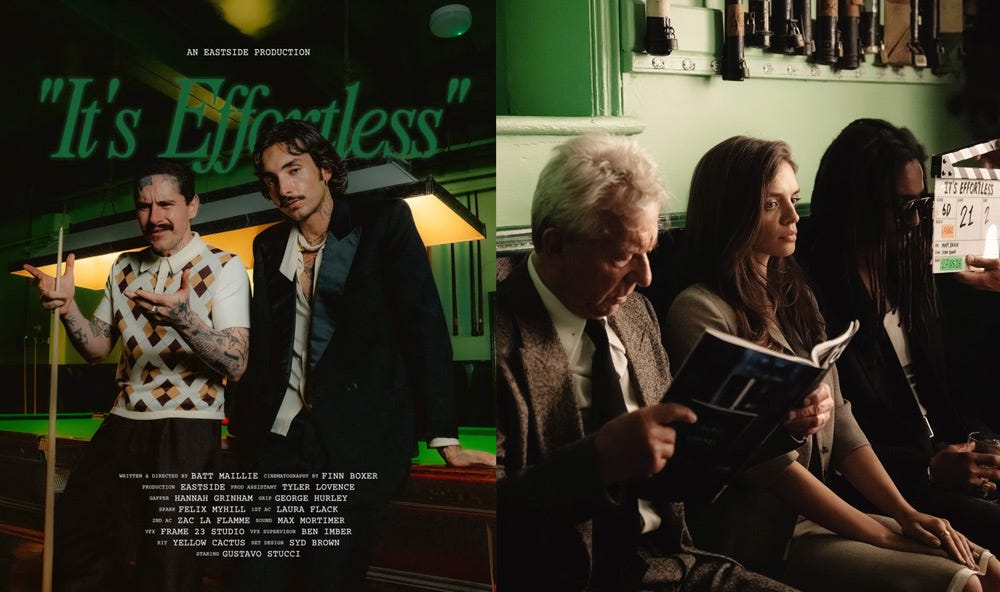
Recent work with Cultured and Chanel titled “It’s Effortless,” marks the duo heating up, while also showing Chanel’s on point with their collaborative curation. They were given carte blanche to capture authentic youth culture, no obligations to make an ad. It’s simple, smart and funny.
BRUCE NAUMAN KONRAD FISCHER
How do I work? How do I draw?
Is the core question Nauman explores in his 21st exhibition with Konrad Fischer.
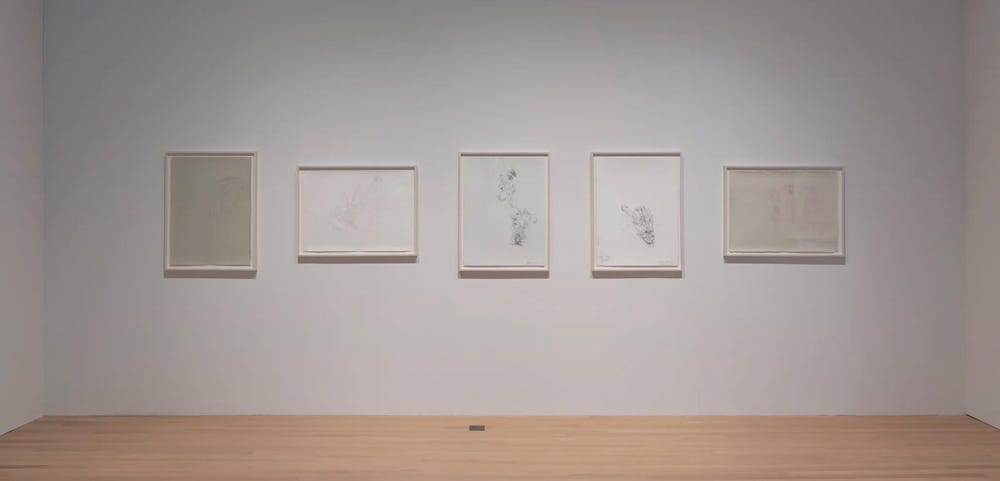
A simple question that is unique to every single person, professional artist or not.
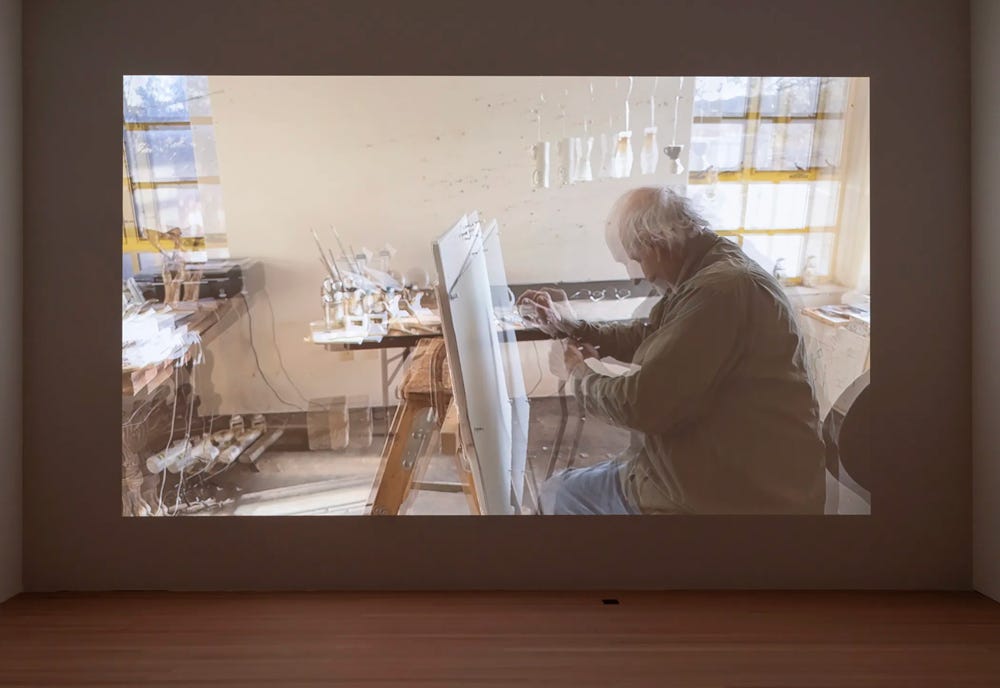
The “blind” drawings in silverpoint or gold, are beautifully simple, marks made on papers ranging from black to pastels, some self portraits, some just gestural line making. Everything is given context as it is surrounded by looping slow motion films of the mark making process of the works. 27 videos change daily, so you can come back for a different experience if you’re so inclined.
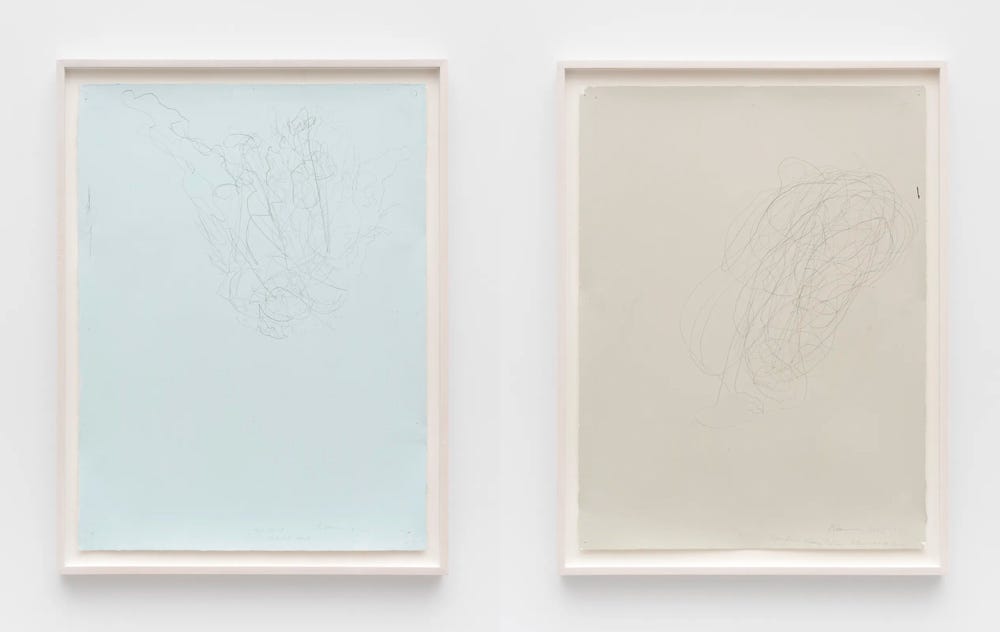
I walk past Konrad Fisher every night on my way home from work, I was drawn to these works the first time I saw them in the window before I even knew they were Nauman’s
The muted color palette and simplicity of the blind works speaks to the minimalist in me.
Konrad Fischer Galerie | New York NY
RYAN MCGINLEY: NIGHT SHIFT
McGinley, whose 2003 Whitney debut The Kids Were Alright made him the canonical millennium-cusp downtown New York “IT” art photographer, has returned to the city for his first NYC gallery show in roughly eight years.
Night Shift (Jeffrey Deitch, 18 Wooster Street, June 13–August 8, 2026) was shot across all five boroughs between 9pm and 5am over 60 nights, spring into winter of 2025. A return to form for McGinely, capturing the spirit of both youth and ever present ‘never sleeps’ energy of NYC. It’s timely, as Ryan said himself;
“New York is on fire right now,”
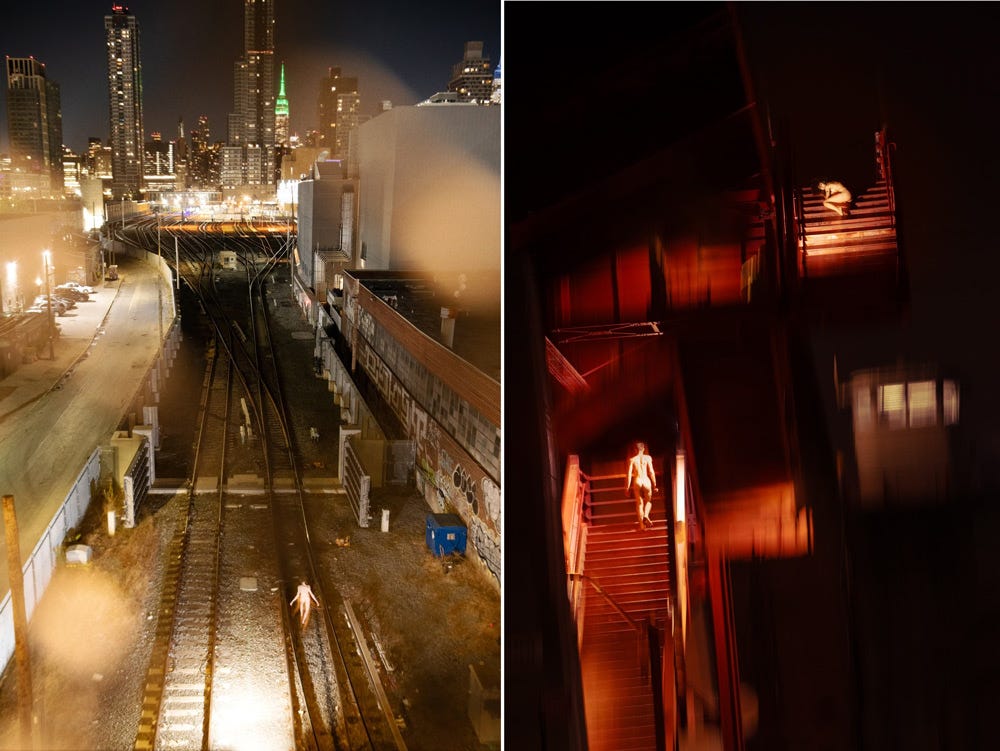
In a fresh interview with Another Magazine, he’s talking about New Yorks return to form, celebratory, electric off the Knicks win and generally a sense that in many ways this city is back. That energy is the backdrop, and subject matter of Night Shift, where McGinley is re-finding his love of New York after a decade of cross-country road trips and editorial/commercial work. This is his first New York gallery show in 8 years.
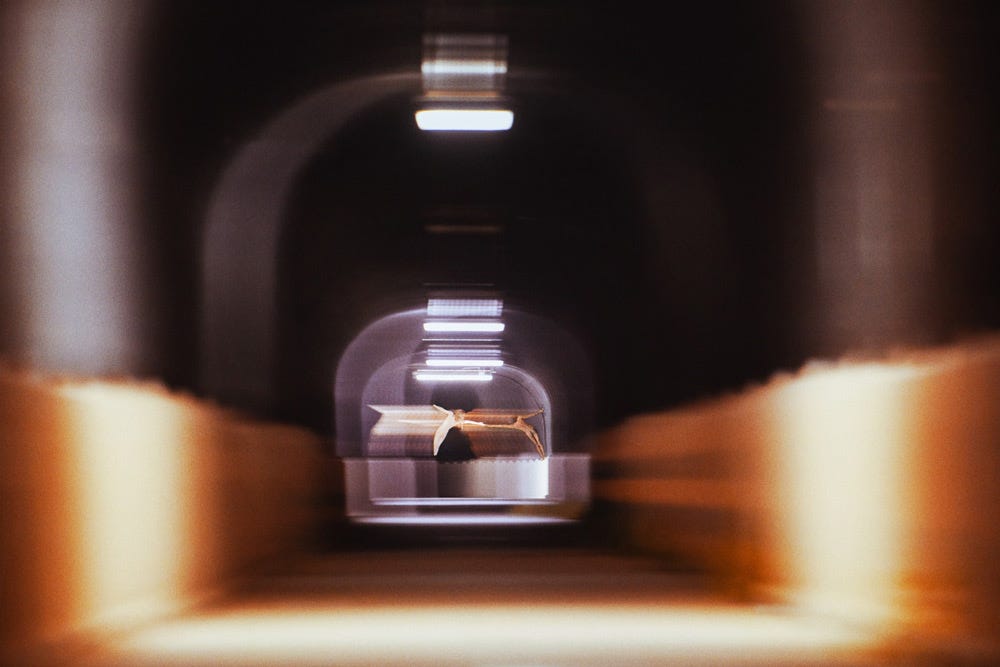
McGinley to me, embodies a certain moment in time that I remember first experiencing in New York; 2003, the Larry Clark / Nan Goldin lineage, the IRAK graffiti crew, the Petra Collins road-trip era. There is a strong creative orbit around Ryan; Tyler Mitchell, Nick Sethi, Farah Al Qasimi, and Dean Majd have all launched from it.
It’s a bit nostalgic, for a downtown that the Kids Were Alright generation has grown out of, but to a whole new generation this is probably a fresh look at the artist’s work.
DON’T SLEEP ON PORTUGAL
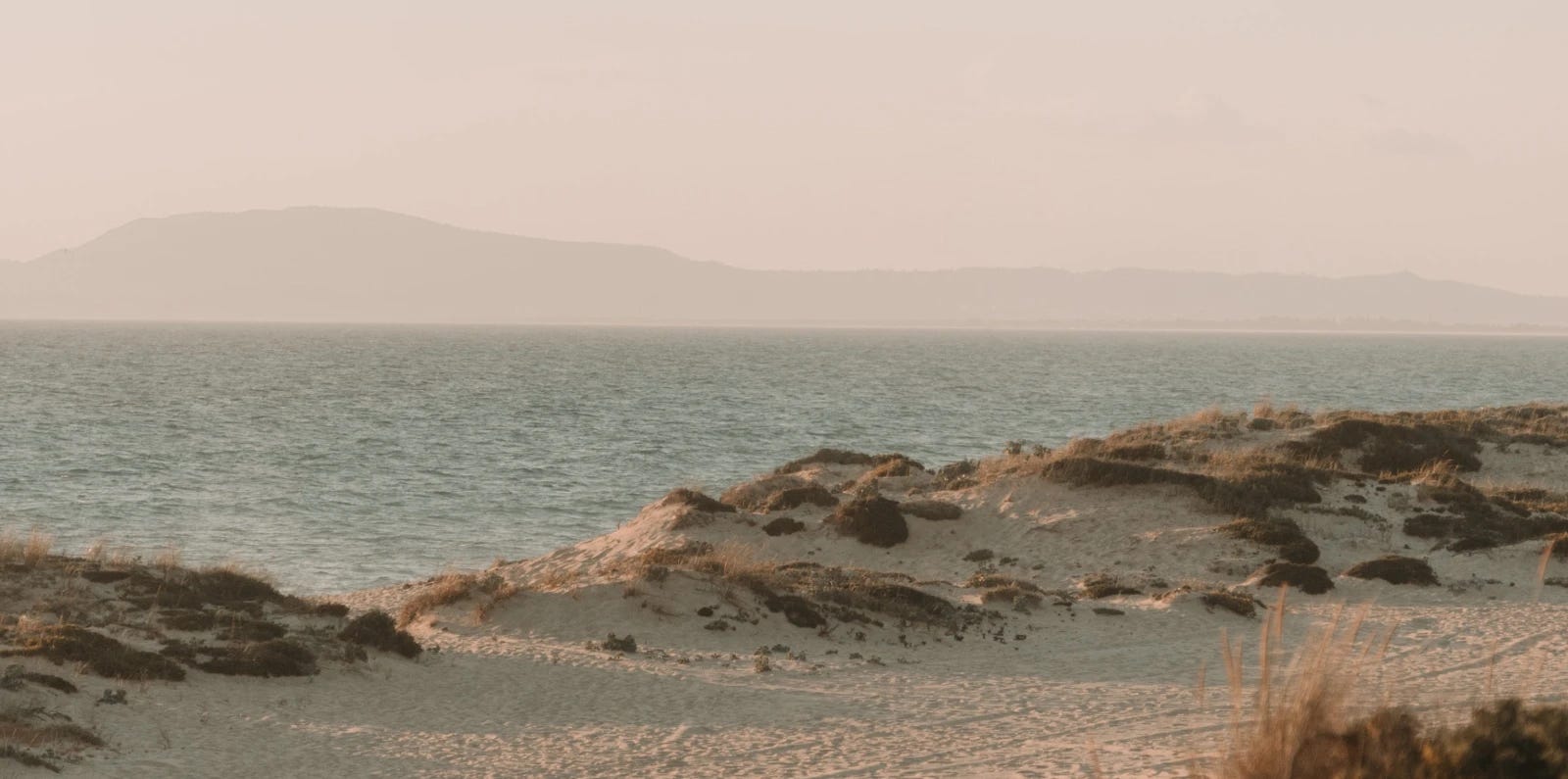
I had dinner with a friend last month whose family is halfway through building a house in Comporta. They bought pre-construction into CostaTerra, and his logic was hard to argue with: incredible beaches, easy access to the rest of Europe, real tax incentives, and reputable developers who give you a sense of security in a foreign market. He’s not on the fringe. American demand is the country’s dominant migration signal right now, with the registered-American population up roughly 50% in a single year, from about 14,000 to nearly 21,000.
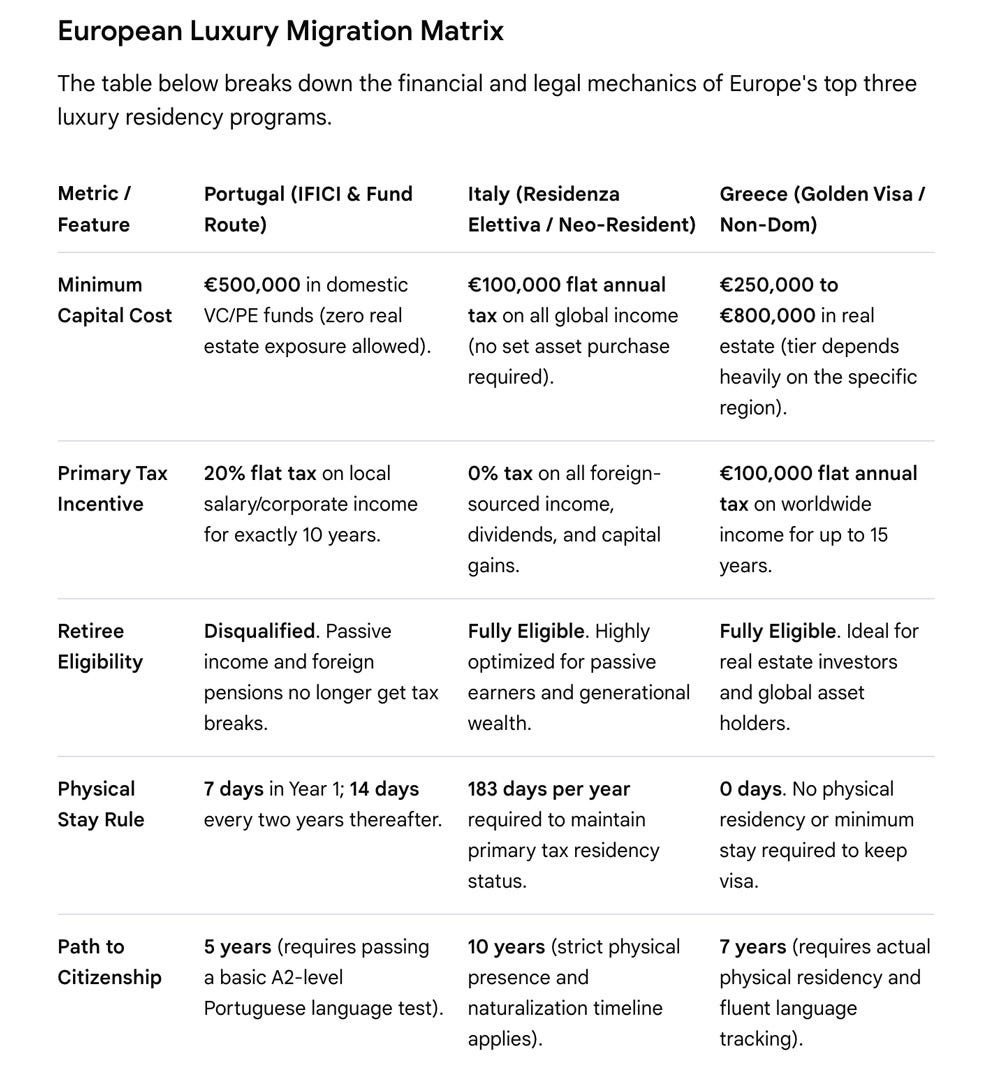
A major catalyst was the Golden Visa, whose real-estate route closed to new applicants in October 2023 after the government decided property-buying through the program was pricing locals out. You used to qualify with a €500,000 property purchase or a €350,000 investment in real-estate rehabilitation. That route ended, but the momentum didn’t. You can still get in through a €500,000 minimum in regulated venture-capital and private-equity funds, with a very low physical-presence bar: seven days in Year 1, fourteen days per subsequent two-year period.
For a wider look at Europe’s top 3 luxury residency programs:
The luxury build-out, especially the Comporta-Melides stretch of the Alentejo, is heating up. Quality of life, favorable exchange rates, and relative value are driving the boom. The aesthetic is rustic, clean, minimal, with a lot more dunes. Summer on Europe’s Atlantic coast feels distinctly different from the Mediterranean: brisker, better surf, more raw.
A few of the major developments and hospitality offerings coming to market:

CostaTerra Golf & Ocean Club is the anchor, developed by Discovery Land Company, the same operator that runs Montana’s Yellowstone Club (Bill Gates among the members). Discovery now runs 35-plus clubs globally.
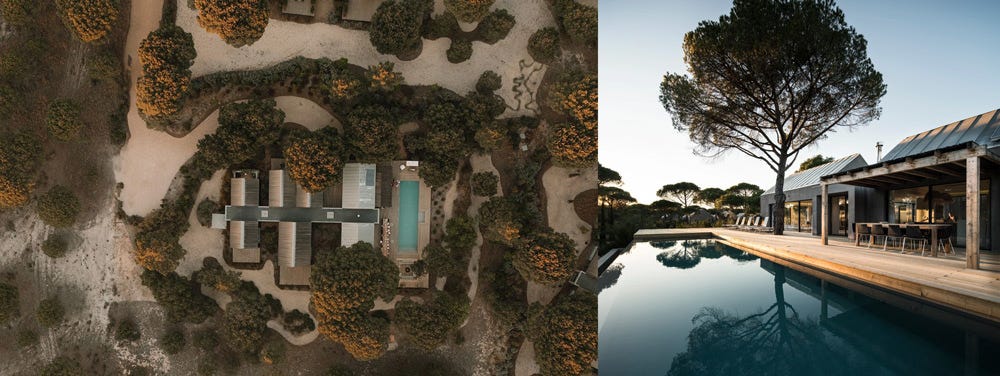
Sublime Comporta opens this year with 43 private villas, heavily positioned around wellness and sustainability.
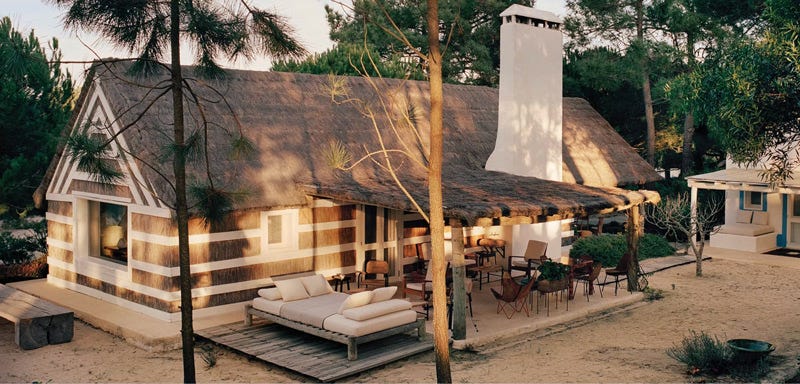
Atlantic Club Comporta is a private-membership residences project with hotel-grade service, debuting this summer.
Bigger players are not far behind: Six Senses Comporta, part of the Espírito da Comporta development, is slated for a 2028 opening.
Iconic owners in the region include Nate Berkus and Jeremiah Brent, whose 18-acre farm in rural Alentejo just ran in AD. Madonna bought in Sintra and has reportedly been scouting Comporta. George Clooney sightings abound, most likely tied to Mike Meldman, who is both the founder of Discovery Land and a co-founder of Casamigos with Clooney.
Too much attention can be a bad thing.
Christian Louboutin reportedly sold his Comporta property because it got too “sceney.” I doubt long-time residents love the attention Comporta is getting. It’s great for developers and speculation: land prices have doubled in five years, and a local campaign group called Dunas Livres is fighting eight mega-projects across the dunes. At what point does “the Hamptons of Portugal” stop being a compliment.
ROLEX BOUTIQUE IN THE SKY
Luxury retail is becoming an arms race with houses going great lengths to create experiences like this.

Rolex’s new boutique on Mount Titlis, Switzerland is scarcity, experiential marketing and retail all rolled into one. Getting to the summit requires a train, two cable cars, and the world’s first revolving gondola, after all that you still can’t just buy a watch, you can get on a waiting list.
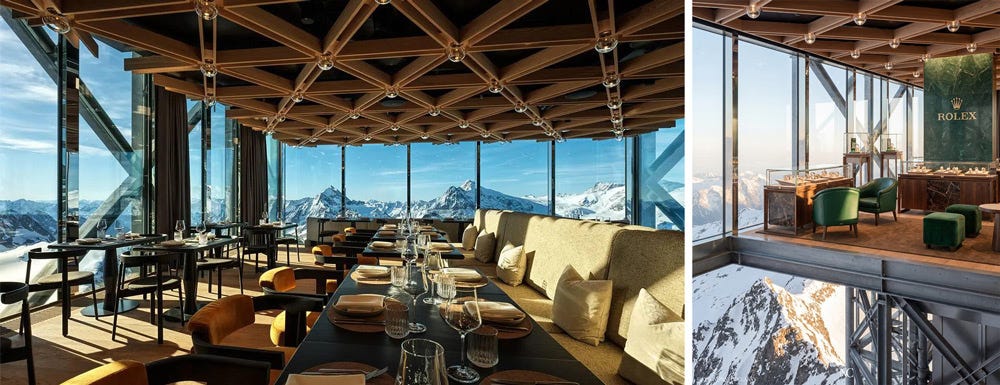
Herzog & de Meuron (Pritzker winners; Tate Modern, Beijing’s Bird’s Nest, Allianz Arena) repurposed a disused 1980s telecom antenna. The interior is a warm juxtaposition of the bond villain exterior aesthetic, natural stone, warm wood, a Verde Alpi green marble wall, with floor-to-ceiling glass providing views of the alps. The pilgrimage pays off with the retail, along with a 140-seat restaurant, a bar, and an observation terrace.
MOTHER DESIGN SHOP
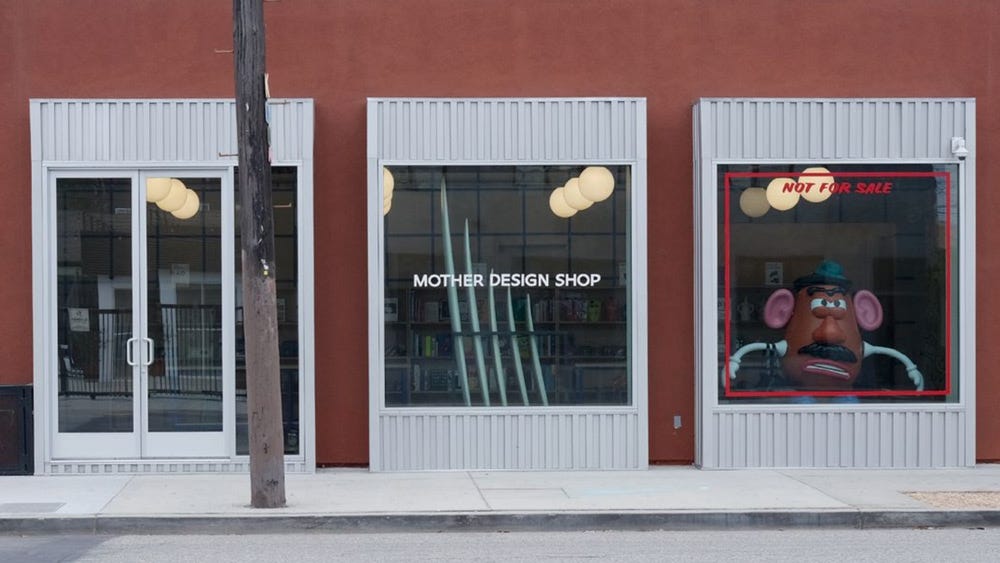
Mother Design, the design arm of independent agency Mother, just planted a flag in a fresh lane: a retail shop in LA’s West Adams, a block from the parent agency’s new 15,000 sq ft headquarters.
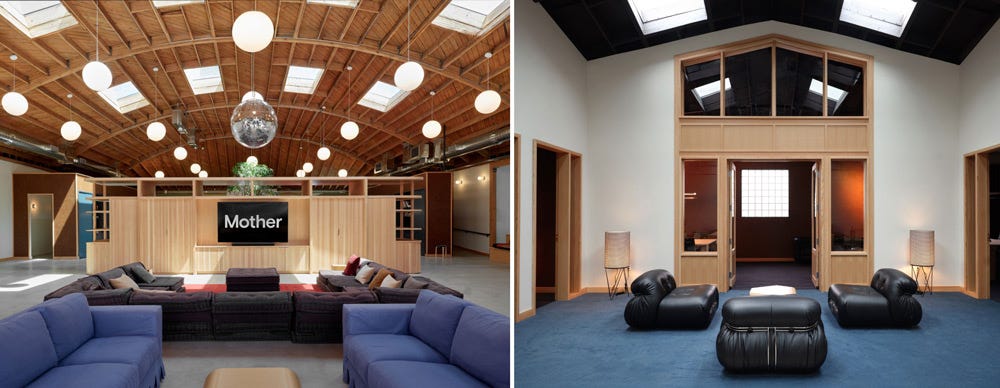
The space is “dedicated to analogue craft,” stocking objects from Mother’s creative orbit (Teenage Engineering electronics, Tyler Warren surfboards, Filthy mixers, Nuud gum, Fhirst soda, Nursem skincare) alongside products Mother designed itself, plus pre-loved books and ceramics. Head of design Mark Sloan calls it “a portal into our world,” and the store trades in cash “or the explicit promise of creative commissions.”
It’s a smart play, and one only a select group of creative-services businesses can run. If your agency is associated with best-in-class design, marketing, and taste, this is how you set the foundation for product incubation. It also works as a brand extension and a community hub in a way a headquarters never can.
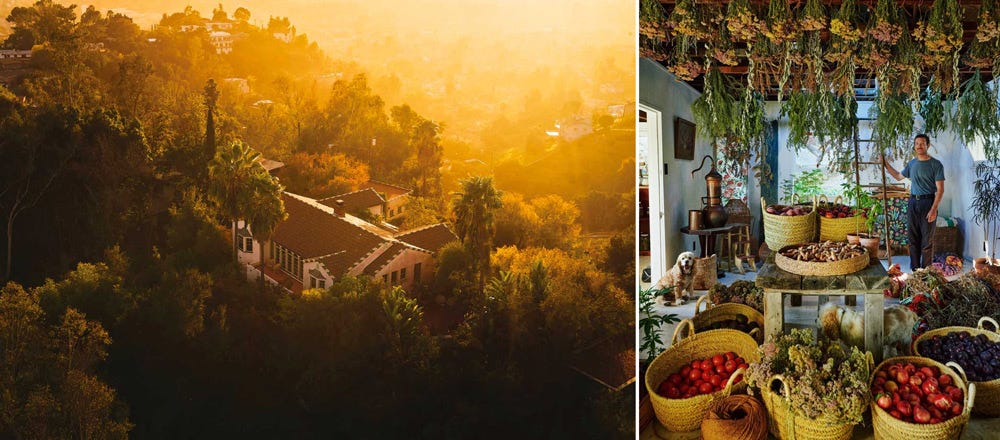
The case study is Richard Christiansen’s Flamingo Estate. It grew out of the creative apparatus he built over years at Chandelier, the studio he founded, then outgrew the agency entirely. That sharply honed branding sensibility now sells everything from $75 strawberries to $250 jars of celebrity-harvested honey and very expensive candles. What’s really happening is a brand world built into the foundation for an entire house of products. I would not be surprised if a major acquisition happens in the next 18 months.
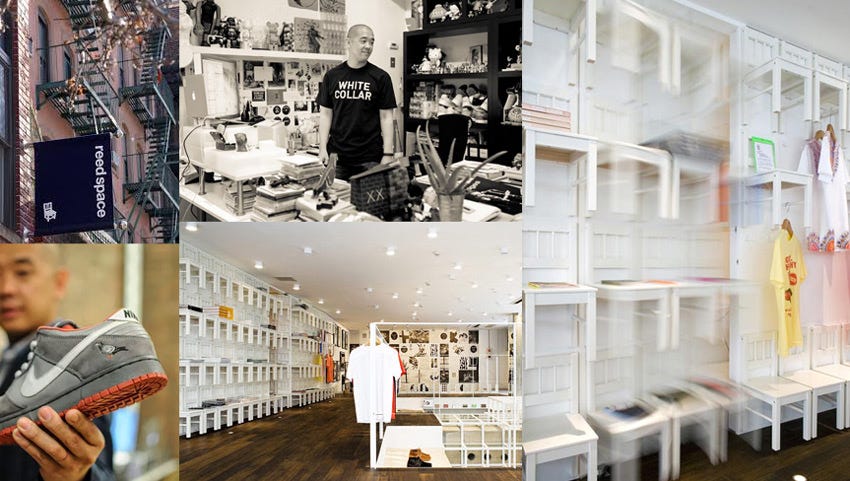
Jeff Staple deserves credit for being early. He ran Reed Space in front of Staple Design on the LES in the aughts, which took him from a designer to a brand that holds strong today. The store secured a coveted SB license in NYC and led to the iconic Pigeon Dunk.
Partners & Spade is another New York analog. Andy Spade and Anthony Sperduti ran their Great Jones Street office as a weekend retail and gallery space, curating products and backing emerging designers while building brands like Warby Parker and Shinola.
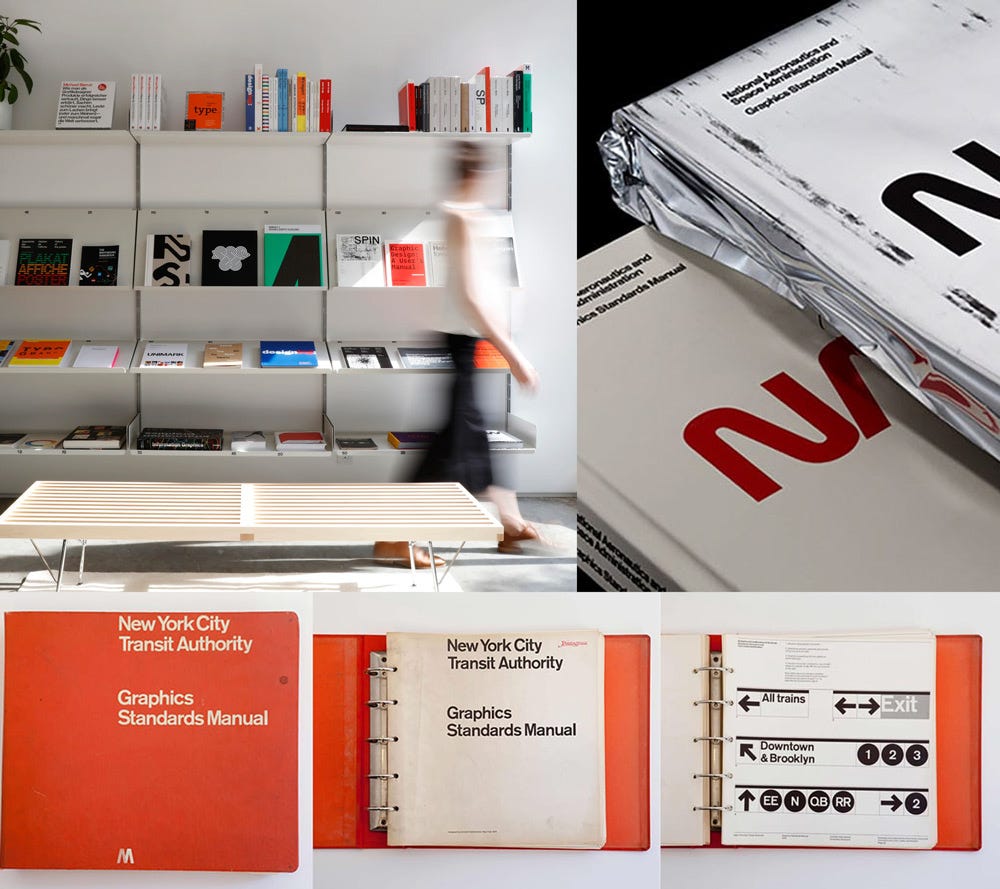
On a more niche level, Standards Manual in Greenpoint is a curated bookstore adjacent to the branding agency of the same name. They specialize in, you guessed it, design standards manuals. I got my NASA standards book there, one of the best design books I own.
Another is Casa Savvy, my friend Rafael Prieto’s hybrid space combining his design practice, a well-curated bookstore, and a recently opened residence. He also makes chocolate.
We think a lot about what a MATTE version of this would look like, daily.
HERMES LONDON
“It’s now almost expected for the world’s biggest fashion brands to open shops that double as art galleries, restaurants or even private members’ clubs.” — Natalie Theodosi, Fashion Director, Monocle, June 2026
I believe the future of retail is fewer, deeper destinations, Hermès just backed that up with its sixth flagship worldwide at 166 New Bond Street.
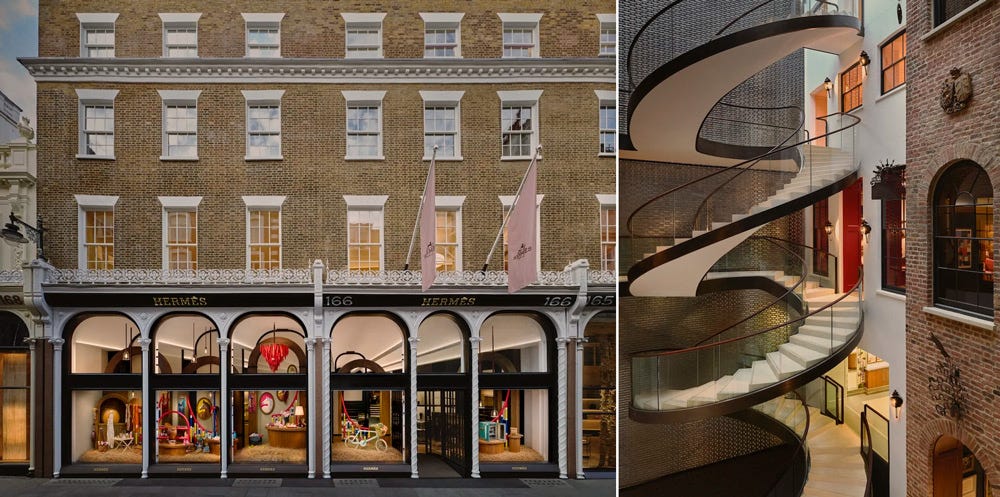
What I’m astounded by is the TIME they’ve invested into this project. Seventeen years after buying the former Asprey building and after a six-year refurbishment, they bring us a staggering, soulful brand experience that spans six interconnected buildings (dating to 1769), 55 color-coded rooms, five floors into roughly ~20,000 sq ft of selling and storytelling.
This is an homage to craft and history. Rather than flatten six Grade II-listed buildings into one box, Denis Montel of RDAI gave each its own identity. They kept the rooms overlooking Albemarle Street where Florence Nightingale once did her research, turned Victorian actor Henry Irving’s former apartments into the fine-jewelry floor, and restored an early-19th-century mosaic floor they uncovered mid-renovation.
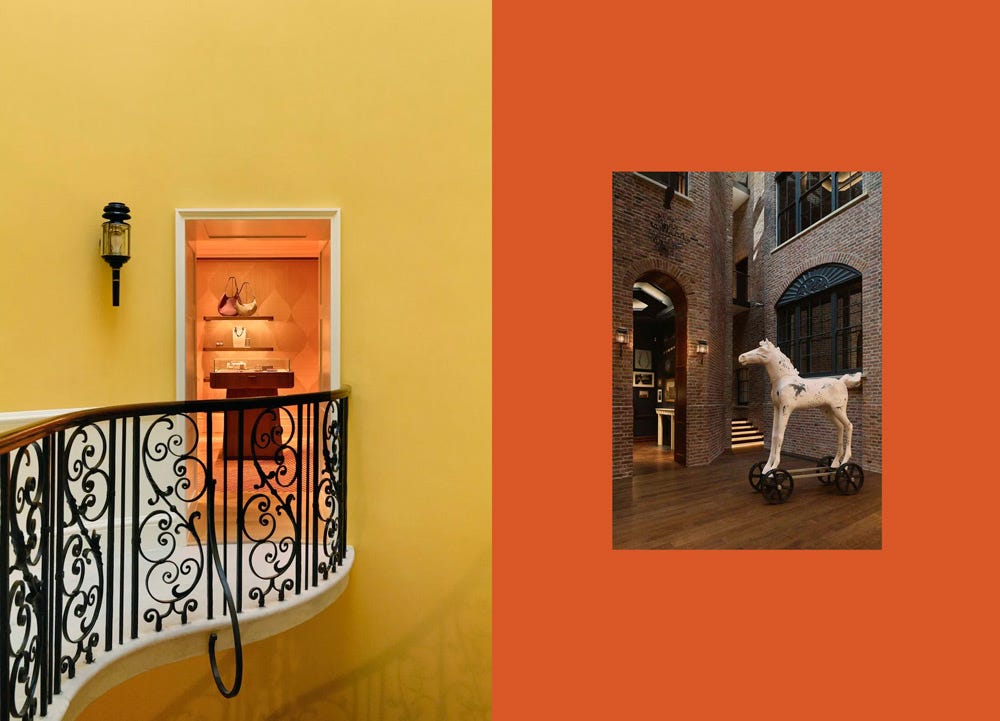
An original Victorian lift was brought back by the only remaining Victorian lift mechanic in the UK. There is an on-site repair atelier where Alexandra Cappe mended 700 bags last year. The building has soul.
It can afford to. While the broader luxury market slid through 2025, Hermès closed the year at €16 billion in revenue, up 9% , leather goods and saddlery up 13%, a 41% operating margin. Revenue has nearly doubled since 2021.
Hermes is testament to not playing the volume game.
MIDJOURNEY SIDE QUESTS
“We’ve dreamed of something as powerful as MRI, and as casual as a trip to the spa, and we’re unveiling a path to that — today.”
— Midjourney, company blog post, 2026-06-18
Midjourney came out of nowhere with Midjourney Medical and the Midjourney Scanner, a full-body ultrasonic-tomography machine that lowers you into a shallow pool of water and reconstructs a 3D map of your insides with no radiation.
This is a clean example of the next era of wild aspiration, where trained-AI companies can point their core competency, massive compute plus reconstruction models, at physical products and categories ripe for disruption. Companies like Midjourney have the compute, the capital independence, and the engineering confidence to side-quest, and that’s a beautiful thing.
Roughly a dozen people have been scanned, there’s no FDA clearance, and no independent radiologist has verified the resolution claims. But it’s a proof point. Medical imaging is a brute-force compute problem, exactly suited to AI: a ring of sensors firing millions of times a second, reconstructed into slices fine enough to read. A machine like this had never been built, because the data volume was previously intractable. The same server build-out powering AI is what unlocks it.
Midjourney has the luxury to explore like this. It never raised VC, describes itself as community-backed, and is profitable enough to self-fund the first spa. The market noticed the partner supplying the silicon: Butterfly Network, whose ultrasound-on-chip the Scanner licenses under a deal worth up to $74 million over five years, popped more than 30% on the news.
This is the first of eight major announcements Midjourney plans for 2026.
A FRONTIER WITHOUT AN ECOSYSTEM
“There’s more monetization of Xbox games happening on YouTube than at Microsoft.”
Satya Nadella
Satya Nadella had a lot to say this month. On the NYT’s Hard Fork podcast, he admitted YouTube monetizes Xbox content better than Microsoft does its own games, conceding the company spent 25 years “subsidizing that entertainment” rather than monetizing it.
That landed right as Xbox’s new CEO Asha Sharma told staff the division needs a “reset,” with significant layoffs expected once the fiscal year closes June 30. The math is rough: Xbox has poured more than $20 billion into content, platform, and hardware over five years while annual revenue slipped by nearly half a billion.
Then he published a sweeping essay that crossed 60 million views on X, “A frontier without an ecosystem is not stable,” arguing the defining risk of AI isn’t capability, it’s concentration. He compares it to the first wave of globalization, where the headline numbers looked fine while industrial economies got hollowed out.
“The last thing any of us want is a world where every company across every sector is ceding value to a few models that eat everything they see. If all the value is accrued by only a few models, the political economy will simply not tolerate it. There is no societal permission for an AI future that hollows out entire industries.”
Satya Nadella
His proposed exit is a “learning loop,” a proprietary feedback system that compounds human judgment and AI so value stays with the business instead of flowing to the frontier lab.
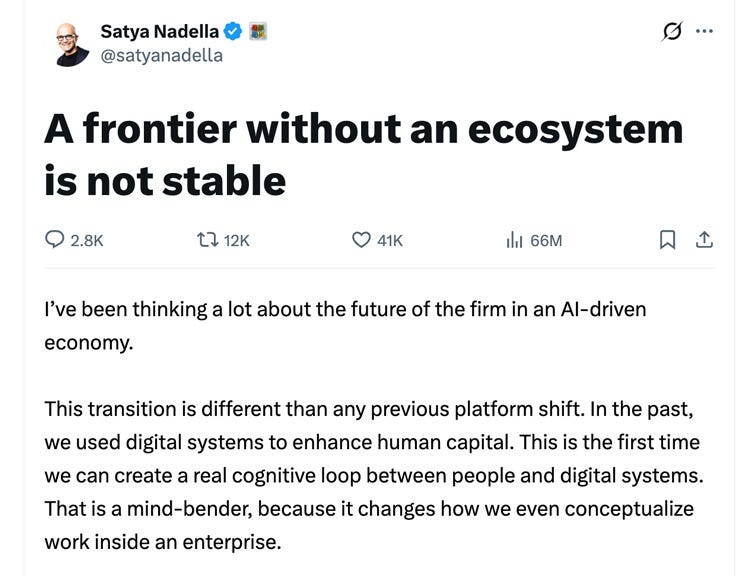
The essay surfaced the same week Microsoft was hit with a shareholder class action alleging it inflated its stock by overhyping AI while concealing slowing Azure growth.
The full essay here.
