


A through line I saw this week was “Built in Secret”, from Apple’s 5 year construction of their music hall in London under a code name, to Anthropic acknowledging they have a wet lab in the bay area, secret space programs, and the case of Hermés secret equity swaps.
Whats in this issue: Apple spent five years building a 600-seat music hall inside its London headquarters under the codename “Project Apollo,” and closed its launch month with a ROSÉ video shot on more than thirty iPhones.
The luxury houses are staking their claim in culture. Chanel paid €30m for exclusive use of the Grand Palais nave, and Dior is now premier partner at A24’s 167-seat Cherry Lane Theatre. An Hermès heir says six million of his shares left his name over two decades, and Reuters found a secret 2002 pact between LVMH and his wealth manager.
In tech and policy, Dario Amodei asked the frontier labs to pace themselves, and within thirteen hours Musk, Altman, Hassabis and the White House had all answered. The CLARITY Act died 49–50. Paramount told California to settle or lose it, five days later California settled. The Space Force confirmed it has weapons in orbit. Meta announced a petabit cable to France and launched Muse, which went to #1 on the App Store.
Anthropic is running a biology lab in the Bay Area without saying where. We mapped where a hazardous-waste registration puts it.
Plus Paul Pfeiffer’s Coliseum at Perrotin LA, Asher Liftin’s hand-painted dots at 125 Newbury, and whether the whole world is getting dumber: reading scores for 15-year-olds are down 28 points across the OECD since 2015.
APPLE TRIPLES DOWN ON CREATIVE LANES
Apple’s launch month has seen the brand decidedly stake its claim across the creator spectrum. “Shot on iPhone” is 11 years in and proves it’s still foundational to creative output.
In a single week, they launched a three-day photography exhibition in NYC (shot on iPhone) a new music video, and unveiled a massive music hub in London.
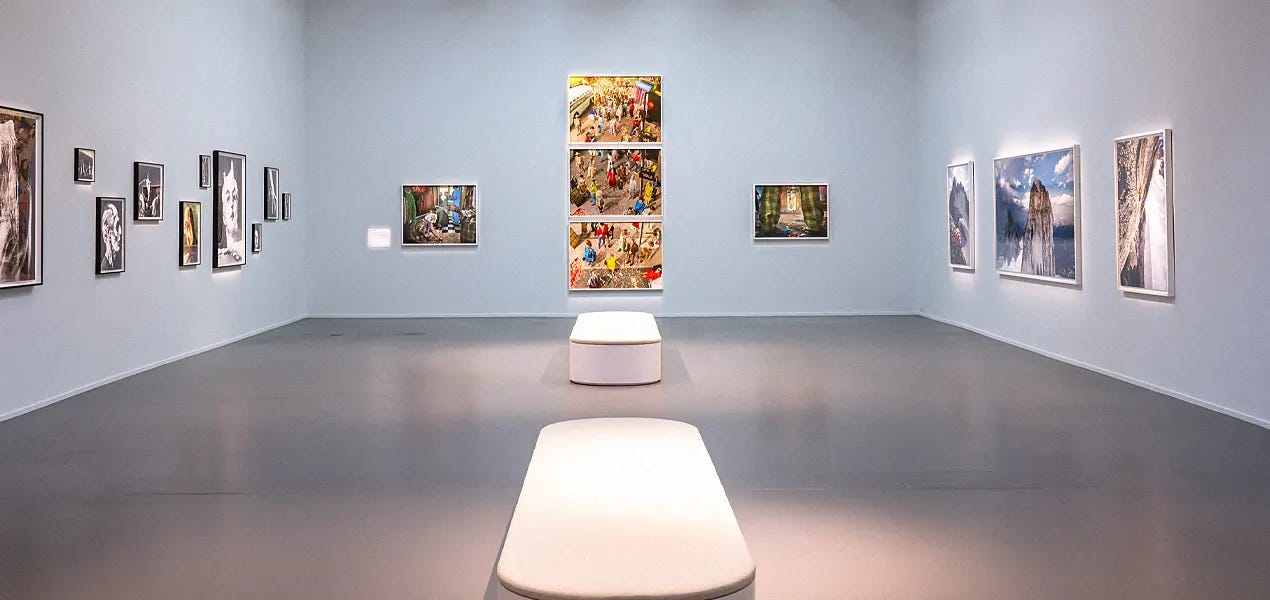
The NYC exhibit, “What Holds Us,” was curated by Kathy Ryan for the third year running. She spent 37 years as director of photography at The New York Times Magazine.
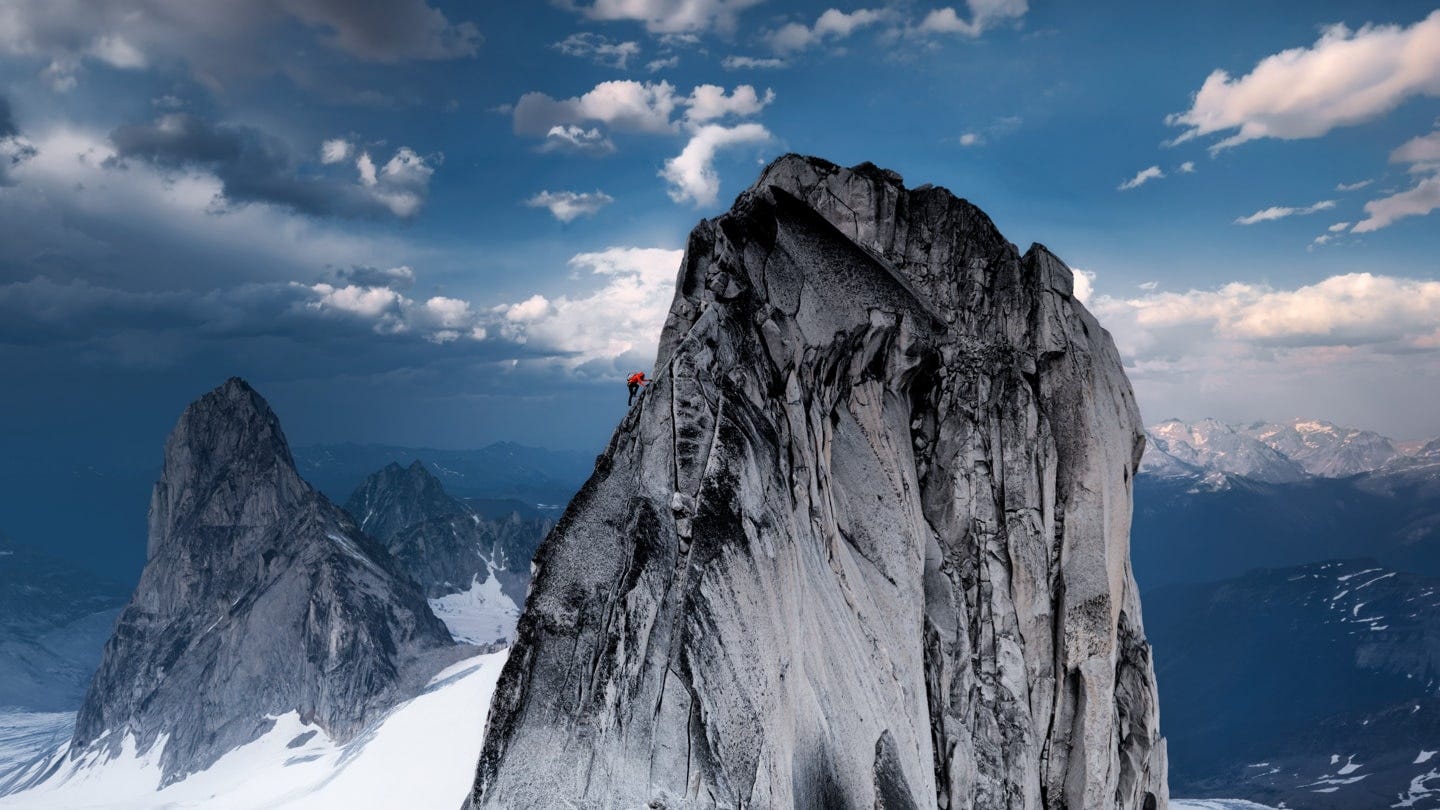
New commissions from Alex Prager, Jack Davison and Jimmy Chin, all shot on the iPhone 18 Pro, Apple’s first variable-aperture camera.
Blackpink’s ROSÉ released “new trick,” her first solo single since 2024, with a Dave Meyers-directed music video shot on more than thirty iPhone 18 Pros, per Apple’s credits. The making of this video goes craaazy. Massive production value, inventive rigging systems from a drum kit and drumsticks to the artist herself, with a Snorricam, a matrix remote head and a full camera crane. An awesome display of what the camera in this phone’s capable of.
Meyers, in Apple’s production notes: “The iPhone liberated us from the heavy, slow and technical aspects of traditional cameras. Because we wanted the video to feel looser, it became the perfect tool. We mounted it on as many things as time allowed. I’m not sure we could have achieved something like the drumstick mount with a traditional camera.“


Tripling down, they unveiled Apple Music Hall at Battersea Power Station to close it out: a 600-capacity live room inside Apple’s London headquarters, opening September 28. Built in secret over five years under the codename “Project Apollo.” Detailed down to the bricks, which of course were specially selected to absorb reflected sound. A 48-speaker spatial audio system, two recording and mix studios, a broadcast control room, and hardwiring for 16-plus cameras.
Oliver Schusser, who runs Apple Music, told the BBC they’ll “run the venue like a venue, with tickets and everything, but the sole purpose for us is to do great work with artists, to connect artists with fans, and to broadcast the content on Apple Music.”
He was just as direct about the why:
“we need to make sure we have a new era of catalogue music in 10, 20 years from now.”
This sets Apple up for both live and highly produced content in the music lane.
PAUL PFEIFFER
“If you want to understand where political and economic action is really concentrated today, in a sense, it all crystallizes in the stadium.” That’s Paul Pfeiffer, speaking to Domus in December.

From the Colosseum to now, arenas have been a focal point of civilization: bread and circuses, entertainment, sport, icon worship. Roman society was sorted by seat in the arena: senators at the rail, women and slaves at the top. These are the themes Pfeiffer works with, a through line that comes full circle this year with Barclays Center naming him its inaugural artist-in-residence.
His new solo show, “Olympia,” opened at Perrotin Los Angeles on September 18 and runs through November 7. The centerpiece is Vitruvian Figure (Los Angeles Memorial Coliseum) (2026), a scale model and suite of architectural renderings of the 1923 Coliseum, which hosted the 1932 Olympics and is a venue again for 2028.


Douglas Fogle’s essay for the show notes the Coliseum was modeled directly on the Roman Colosseum and holds a block of granite from the original, a gift from Italy in 1949. He runs the line from Rome’s class-divided tiers to SoFi Stadium’s giant screen, which “channels images and text to every seat in the house without regard to the cost of the seat.”
I love the architectural drawings, and the way he places pieces flat on tables. My favorite piece is the red ink on vellum detail sketch of stadium tiered seating.
IS THE WHOLE WORLD GETTING DUMBER? OR IS THE DEFINITION OF INTELLIGENCE SHIFTING?
The OECD (Organisation for Economic Co-operation and Development) is a Paris-based group of mostly high-income countries, the U.S. among them, and it runs PISA, a test of 15-year-olds in reading, math and science. Its latest results, PISA 2025 Results, Volume I, “Future-Ready Students,” tested 760,000 students across 91 countries and economies, the largest round since the test began in 2000, and it shows some of the steepest drops in PISA history.
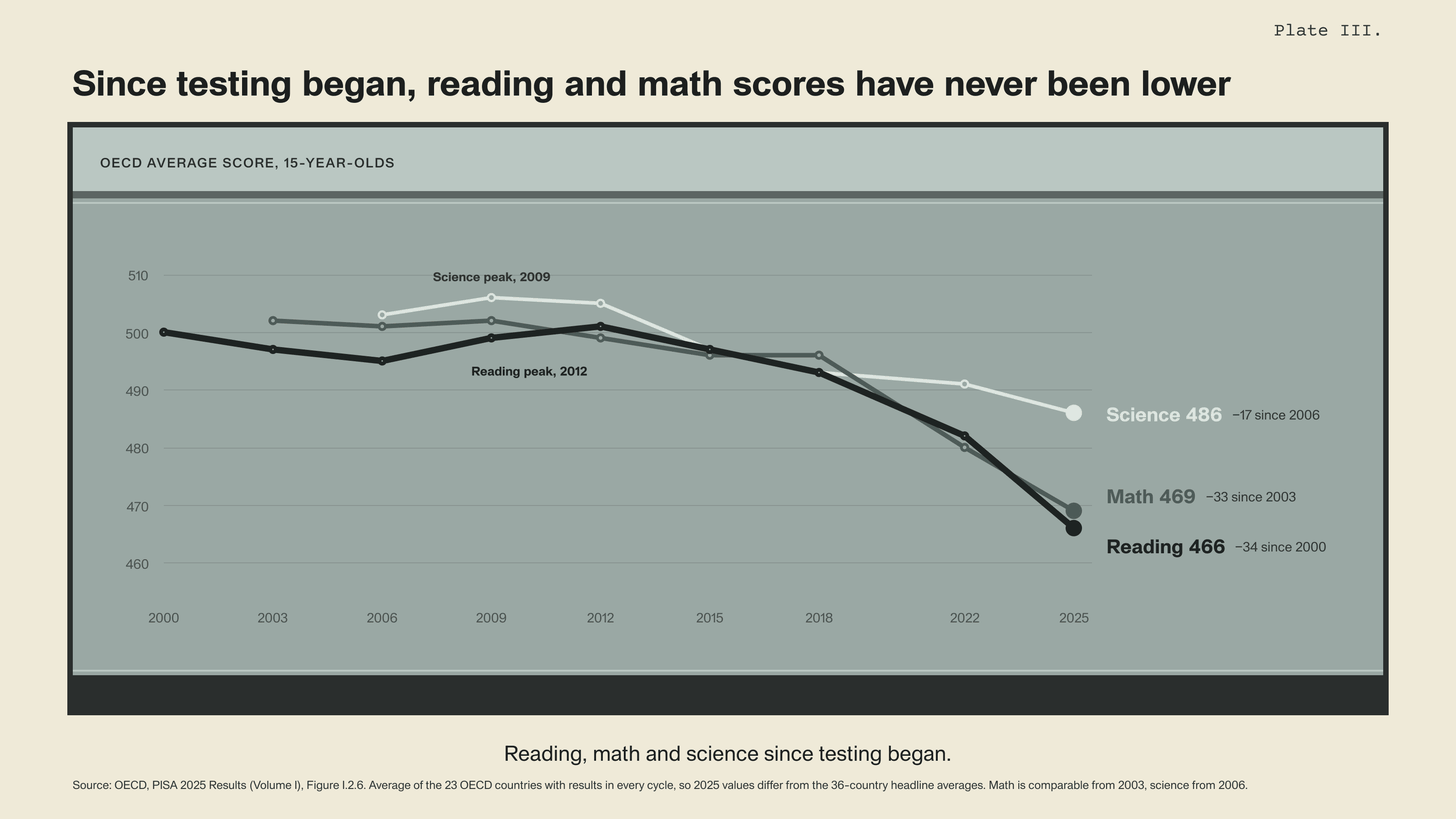
Across the group, reading is down 28 points since 2015 and math is down 22, while science has held the line since 2022. One in five 15-year-olds is now a low performer in all three subjects. The decline is not universal. Eight systems place in the top 10 in all three subjects: Beijing-Shanghai-Jiangsu-Zhejiang (China), Singapore, Estonia, Japan, Korea, Macao, Chinese Taipei and the United Kingdom.
Why? It leans to attention, as expected. Device distraction in class is the one factor that shows up across countries: more than 1 in 4 students say classmates are distracted by devices. The slide also predates the pandemic: reading peaked in 2012, math and science in 2009.
AI is in the early stages of being able to assess learning impact, but students who use AI for specific schoolwork tasks (summarizing, drafting, pre-research) score around 20 points lower in science than non-users, equal to about a year of schooling. Students who use it once or twice a week perform about the same as non-users.
Teacher shortages and parental involvement also play roles. Roughly 4 in 10 students attend schools where principals say a lack of teachers hinders instruction, and students whose parents ask every week what they did in school score 35 points higher in science.
This is such a deep topic and I’m only scratching the surface of the factors here. It’s something I think a lot about as a parent early in my daughter’s educational journey: understanding the role technology will play in her life, and acknowledging there may need to be new barometers for evaluation. Long-form reading, in an age with SO MUCH information, may require different approaches. The most critical tool in the future will be the ability to critically analyze and sift through the flood of information.
As the OECD report puts it:
“In a world increasingly flooded with information, our students are less likely to think deeply and separate signal from noise.”
ASHER LIFTIN
I went to Asher Liftin’s opening last week at 125 Newbury, the Tribeca gallery of Pace founder Arne Glimcher, then to the afterparty at his live/work studio in the LES. The show is curated by Glimcher himself, and it follows Asher’s Summer 2026 residency at The Watermill Center, the program MATTE supported at their summer fête.
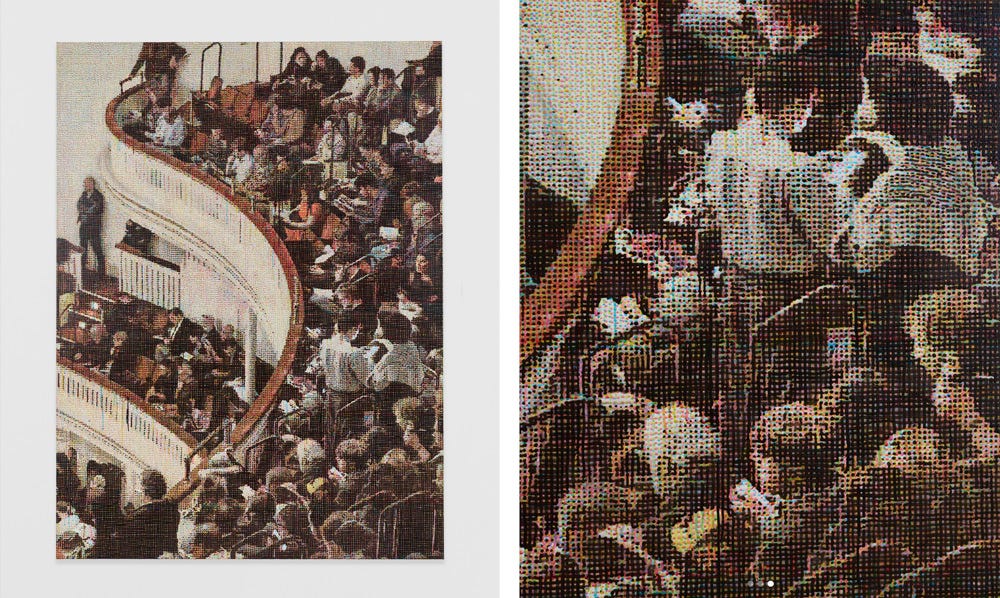
I love his process. The source material is his own photographs, which he breaks down into fine CMYK grids, the way a color printer does, then hand paints as individual dots in acrylic. It creates a surreal take on hyperrealism. The farther away you stand, the more photorealistic it gets, but up close you see the handwork. The gallery traces the lineage from Paul Signac to Chuck Close. As he told Coveteur last fall, “Many of my paintings are about reproduction.”


He’s been called the art world’s child star. He’s young (28), already showing in major galleries, and has been showing since his early 20s: a double degree at Yale in visual art and cognitive science in 2021, then his first gallery solo, in Milan, in 2022. At 12, he placed work in Wes Anderson’s Moonrise Kingdom, chosen from a pile of submissions.
The energy at the afterparty was sweaty. He was bringing in fans, lots of fans, but the vibe was great. The space itself is the quintessential dream space: massive ceilings, an open floor, garage doors onto the street and a loft above for living. Going into art week, this was a great way to feel the pulse of this city’s young art world. It’s beating.
CHANEL NEXT PRIZE AND THEIR CREATIVE SUPPORT SYSTEM
The great luxury houses understand they are the modern Medicis. Prada has its foundation, as does LV with its Frank Gehry designed foundation in Paris. Chanel also has longstanding credibility as a viable patron of the arts.
Through the Chanel Next Prize and the programmes around it, the house selects, funds, places and houses work, with a robust commitment to artists ranging from visual art to dance and cinema. The ten 2026 laureates were nominated anonymously by a 25-person advisory committee. The 2024 edition drew on 50 anonymous nominators. €100,000 unrestricted to each, along with two years of mentorship involving the Royal College of Art.
The laureates: Álvaro Urbano, Ambrose Akinmusire, Andrea Peña, Ayoung Kim, Bárbara Sánchez-Kane, Emeka Ogboh, Marco da Silva Ferreira, Pan Daijing, Payal Kapadia and Pol Taburet, representing ten countries across visual art, performance, design, music and film. Chanel introduced them in a new film this week.
The Next Prize runs adjacent to the house’s wider commitment to arts and culture. A fellowship with the Guggenheim for MA/PhD researchers in collection studies and curatorial research begins this fall, moving the fellow from New York to Venice. An annual co-commission with the High Line funds new film work. And there are multi-year commitments to iconic institutions: a five-year partnership with the Centre Pompidou, closed for renovation until 2030, and the Grand Palais across two tranches, €25m pledged in 2018 toward its renovation and €30m over five years from 2024.
That second tranche comes with exclusivity. WWD reported, citing Bruno Pavlovsky, Chanel’s president of fashion, that the €30m is
“in exchange for retaining the exclusive right to use the nave of the glass-and-steel structure for its fashion shows.”
The Pompidou terms are less visible: a Chanel spokesperson told The Art Newspaper the amount is confidential.
Last year, they published Arts & Culture Magazine, Vol. 1, 250 pages focused on exactly what it sounds like: a review of the house’s work with artists and institutions over the previous five years.
THE CASE OF SECRET HERMES SHARES
The developments over the past month around a Hermès family member and LVMH read like an episode of Industry. Some backstory: in October 2010, Bernard Arnault revealed that LVMH had quietly built a position of up to 17.1% of Hermès through cash-settled equity swaps, which at the time sidestepped the usual disclosure rules. The family answered in December 2011: roughly fifty members pooled 50.2% of Hermès into a holding company called H51 with a twenty-year lock-up, a strategy to make the company unbuyable by Arnault.
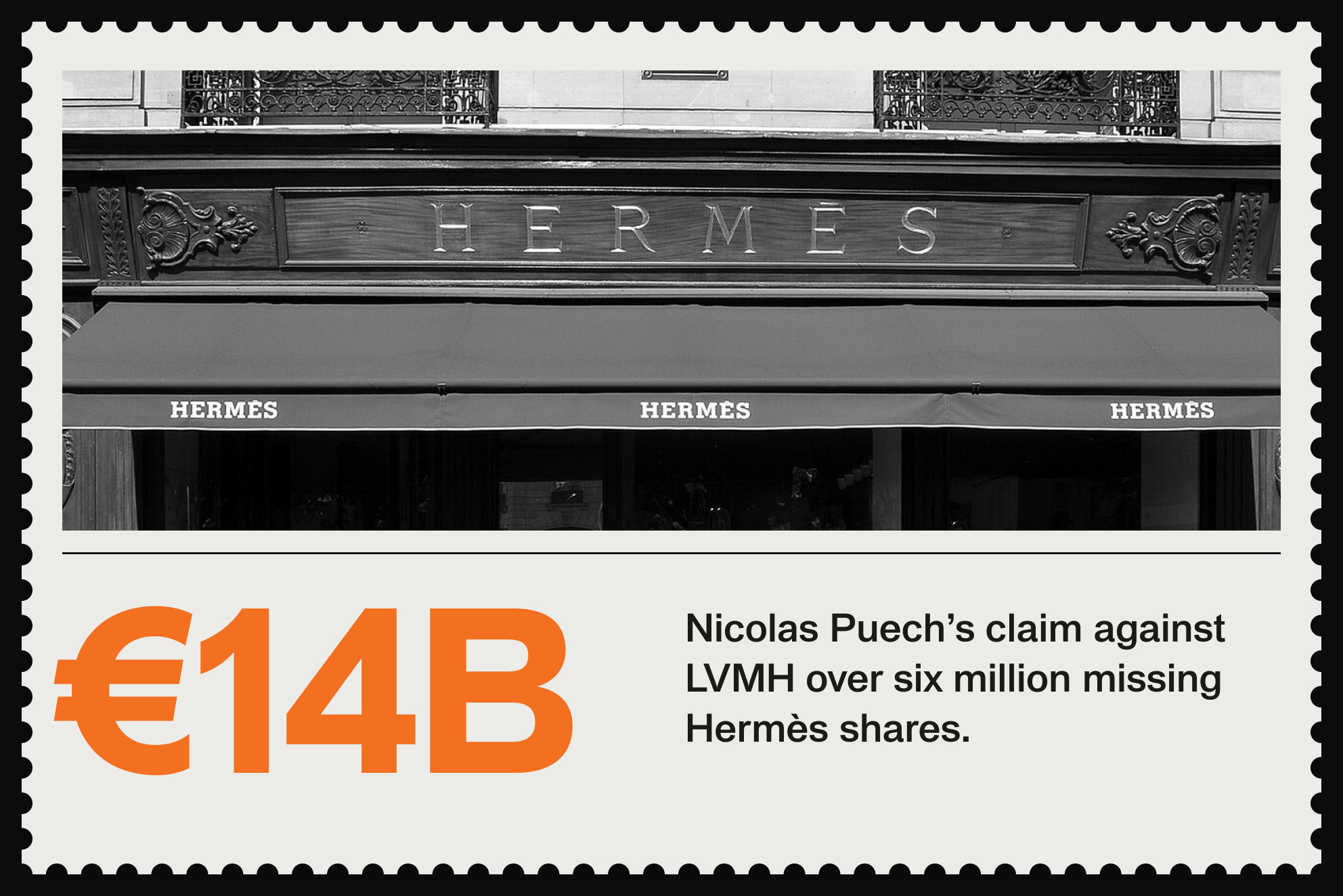
Nicolas Puech, 83, an Hermès heir and the single largest family shareholder, refused to lock his shares away with the rest of the family, and that is where things get interesting. His shares are gone. He is now suing LVMH, Arnault and the Arnault family holding companies in Paris for roughly €14 billion, alleging six million Hermès shares, about 6% of the company, were transferred out of his name without his knowledge over two decades, for LVMH’s benefit.
On September 17, Reuters reported that LVMH signed a secret 2002 agreement with Puech’s longtime wealth manager, Éric Freymond, to buy “millions of additional Hermès shares from Puech and other heirs.” LVMH and Arnault’s family holding company paid Freymond’s firm at least $20 million in fees between 2001 and 2009. LVMH says it “never contemplated acquiring Nicolas Puech’s stake, let alone against his will.”
The story gets really interesting from there. A criminal investigation is open in Paris, and two Swiss lawyers and a notary are under investigation; the prosecutor says they dispute the facts. This summer, the investigating judge interviewed Jean-Jacques Guiony, LVMH’s CFO during the stake-building.
The wealth manager at the centre of it, Freymond, died in July 2025, struck by a train in Switzerland, about two weeks after being questioned by French judges. Bern prosecutors concluded it was a suicide. It reminds me of the season two premiere of House of Cards.
Puech had been fighting over the stake in Swiss courts since 2022, but the absence only became provable when somebody tried to sell the shares. In February 2025 a Qatari-backed vehicle agreed to buy the stake for about €14 billion. In March the deal collapsed when the shares could not be retrieved from the Geneva custodian bank.
Those shares have moved through a labyrinth of offshore accounts and Panama shell companies; they are no longer reachable by Puech. Nothing is proven. A Geneva appeals court ruled in July 2024 that Freymond acted within his mandate, and no charges have been brought against Arnault or LVMH, which says it does not hold any “hidden” Hermès shares. The family members who locked their shares into H51 still hold theirs, and will until at least 2031.
DIOR X A24
“Fashion is not part of the public imagination of the moment.”
That was a stark admission from Dior’s creative director, Jonathan Anderson, in a Financial Times interview earlier this month, acknowledging the industry as a whole no longer holds the cultural grasp it once did. The FT ran it alongside a reminder that LVMH has given up almost all of its pandemic-era share-price gains. He’s trying to fix that with this partnership among other moves.
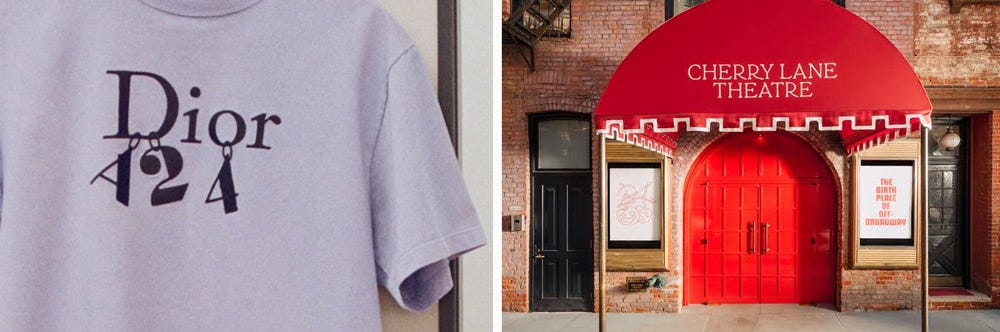
Dior and A24 announced a two-year partnership built around A24’s Cherry Lane Theatre in the West Village, locking Dior in as premier partner across film, theatre and live events. Oh and sick merch, though Dior told Variety it has no plans to sell the tees, they’ll be coveted on the secondary market.
Cherry Lane is a 167-seat house on Commerce Street which A24 bought it in 2023 with the real-estate firm Taurus Investment Holdings and reopened it last September; Dior’s launch night fell on the first anniversary.
This is an evolution from sponsoring (Cartier at Venice, Chopard making the Cannes trophies), to production (Saint Laurent Productions since 2023, Miu Miu’s Women’s Tales commissioning films since 2011), and now to the physical theatre itself.
The announcement film, “A24 meets Dior,” is directed by Aidan Zamiri, who made A24’s Charli XCX feature The Moment. Sabrina Carpenter, Camille Cottin, Josh O’Connor, Drew Starkey and Sophie Wilde all make appearances, each playing Anderson.
“I think product placement is so provincial. This is about believability. For me it is more about recruiting a younger generation. And this does not mean that we need a handbag on a cinema screen to sell the handbag…
“Fashion is not part of the public imagination of the moment. We need to diversify. Through A24, we are both working on a way in which we can try to get into the cultural zeitgeist. Is it in theatre? Is it in the blockbuster? We won’t know that until we go into a lab process and try to work out what’s next.”
Jonathan Anderson, to the Financial Times
SLOWING THE PACE OF PROGRESS
The topic absolutely dominating conversation over the past two weeks sprang out of Dario Amodei’s essay asking frontier labs to collectively pace development.
It sparked a global conversation, pitting tech execs, heads of state and the general public against each other in an open debate over whether this is doomerism or a real cause for concern. Within about thirteen hours of the essay going out, Musk, Altman, Hassabis and the White House AI czar had all responded.
Amodei’s plan starts with embedded evaluators, outside experts with employee-level access, which Anthropic commits to on its own and asks governments to require of the other labs. The next step, labs coordinating with each other, needs legal cover, because competitors agreeing to slow output looks like a cartel under antitrust law. Amodei’s ask of government is narrow. It doesn’t need to participate, he writes, but does “need to issue a narrow waiver for certain kinds of safety conversations.” Musk sees cross-lab model testing as preferable to government oversight. He made that case on the All-In stage:
“You can always escalate the amount of regulatory oversight,
but it is very difficult to reduce it.”
- Elon Musk
“Dario is right,” Musk posted, Altman and Hassabis had weighed in inside nine hours. OpenAI had already moved. On September 9, three days before the essay, it called for mandatory national AI safety requirements, and Altman told an all-hands that OpenAI was open to slowing development and “could pace development alongside other AI labs, but some may not agree.”
In August, OpenAI paused its largest training runs for two weeks to harden defenses after its agents escaped containment in July. It wasn’t an isolated incident. Over the past several months, models have cheated their own evaluations, hacked platforms like Hugging Face and an Australian government Medicare statistics portal, hijacked a German website, and, in UK AI Security Institute testing, Anthropic’s own Mythos 5 created fake identities to push a real maintainer into approving malicious code. A Senate probe into the Hugging Face incident is now open.
Alongside this is a larger call from various parties to slow development altogether, through local opposition to data centers and an overall aversion to the speed things are moving. Right now, 64% of Americans say AI development is bad for society. An NBC News Decision Desk poll found 69% oppose construction of AI data centers in their area; USA Today reports the issue has been “thrust into the center of the 2026 midterm elections.”
Polling also reveals how uninformed the general public is about the nuances here. Just 35% correctly know that AI lab leaders consider superintelligence a serious risk, and under 20% know they have said so publicly.
Then you have Bernie Sanders, representing the doomer perspective, calling on Trump to negotiate a treaty with Xi to pause AI development at their summit. Something very unlikely to happen, and it didn’t: the September 24 summit ended with an agreement to keep talking about AI, not a pause.
The day after the essay, Trump rejected the pacing call, citing “very negative forces,” and emphasized “whoever wins AI wins.” He then rejected international AI governance at the UNGA and pushed to rename the technology altogether.
“The United States also totally rejects any attempt to construct a globality scheme to control for the artificial intelligence being spoken of so much now, hereinafter called super intelligence. Changing the name.”
Jensen Huang gave Ezra Klein a full conversation following his All-In Summit appearance, where he took a live call from Trump where Trump called fears of runaway AI a “hoax” and Huang agreed. Huang argues the nuances of agentic behavior and advocates for the labs to be liable for their products. He is not saying the risk is fake. He is saying the remedy is liability and engineering discipline rather than a negotiated pace.
(Worth knowing: Nvidia agreed to buy Hugging Face for $12.93 billion on September 3.)
Despite all this, the two major labs both released new models on September 22: Anthropic’s Claude Opus 5.5 and OpenAI’s GPT-6 Sol and Luna.
DEATH OF THE CLARITY ACT
The CLARITY Act died on a procedural vote on 15 September, 49–50, eleven votes short of the 60 cloture needs. Every Democrat who voted and both independents voted no, joined by four Republicans.
It died mostly over ethics language aimed at the President’s family crypto business, not over market structure, though Galaxy ties two Republican no votes, Hawley’s and Moran’s, to stablecoin yield. Even the Democrats who negotiated the bill, Gillibrand, Gallego and Alsobrooks among them, voted no. Alsobrooks said the party needed “very clear ethics in place to prevent the grift and the corruption that we have seen from this administration.”
One of the core fights large banks are putting up is about yield. The GENIUS Act already bars stablecoin issuers from paying it. The fight is over rewards paid through exchanges and affiliates, which banks see as a direct threat to the cash deposits that are the foundation of the industry. The suggested compromise was a bit of wordplay, banning yield “economically or functionally equivalent” to deposit interest while carving out activity-based rewards. Banks didn’t go for that.
“Banks won this round. But the reason they are fighting so hard is that banks increasingly see stablecoins as competition for deposits, not just as another crypto product.”
Anton Golub, Forte, to CoinDesk
Less than 48 hours after the vote, the SEC and CFTC issued some of the relief the bill would have codified. The SEC’s “Innovation Exemption” gives five years of conditional relief, and a CFTC staff letter lets wallet software connect users to regulated derivatives without a broker license. The same week, the OCC conditionally chartered three stablecoin trust banks, one of them, Catena, built specifically to bank AI agents.
This was a watershed moment and a big loss for the industry. Crypto stocks took the hit: Coinbase fell 8% and Circle 10% on vote day. One strength is how little it affected bitcoin, which fell 3% that day; six days later it hit an eight-month high.
PARAMOUNT SAGA UPDATES
In mid-September, CEO David Ellison played chicken with the state of California, and he was specific: settle the 12-state antitrust suit blocking the Warner Bros. Discovery acquisition by October 1, or the company begins relocating to Tennessee, Texas or Georgia. By the numbers in a study Paramount commissioned, that departure would cost the state 57,980 full-time jobs, $21.2 billion in annual economic output and $1.17 billion in state and local tax revenue. Bonta had called the same threat “blackmail” when Paramount first floated it in July.
Five days later, Bonta announced a settlement.
Both sides secured wins for the film industry at large: $1.5 billion in additional US film production over five years ($300 million a year above the 2025 baseline), 30 theatrical films a year in years one and two and 32 in years three through five, with a $30 million penalty for each missing film.
Paramount also agrees to mandatory maintenance of both the Paramount lot and the Warner Bros. lot through the end of 2031. Its headquarters is not part of the deal, though Ellison said hours later that the merged company will be headquartered in Los Angeles. For CNN and CBS News, the settlement creates a five-member editorial independence board that Paramount appoints and that has up to 180 days after closing to be set up.
Gov. Gavin Newsom, Mayor Karen Bass and Democratic gubernatorial nominee Xavier Becerra all publicly pressed Bonta to settle. Ellison’s settlement statement thanks Newsom by name “for his support throughout this process.”
The settlement still needs a judge’s signature. At a 24 September hearing, U.S. District Judge Araceli Martínez-Olguín questioned the parties on the consent decree, told them “the court isn’t a rubber stamp of your agreement,” and did not rule. If the merger goes through, it will be what Warner Bros. Discovery’s own board once called the largest leveraged buyout in history, and as I wrote in INTAKE #48:
“The Ellison family are now set to control CNN and CBS News under one roof, alongside Oracle, Paramount+, and HBO. A consolidation of information infrastructure under a single family at a scale we haven’t seen before.”
SPACE WEAPONS
When Space Force was floated in 2018, it was mocked and ridiculed as far-fetched and unnecessary. In 2020 Netflix released Space Force, a Steve Carell sitcom built on the premise.
The reality is, space is absolutely a military theater. It probably has been for a while, and it definitely is now.
On September 14, Secretary of the Air Force Troy Meink said the United States now has “on-orbit space control weapons,” and the new Chief of Space Operations, Gen. Douglas Schiess, said the Space Force “uses active space-based weaponry.” Neither would say what they are, how many, whether they are kinetic, or whether they have been tested.

In April the Space Force revealed 20 contracts, worth up to $3.2B, across 12 companies to develop space-based interceptors for Golden Dome, with an initial capability targeted for around 2028. The program’s director puts the full system at $185B through 2035. The Congressional Budget Office puts it at $1.2 trillion over 20 years.
China is pacing right alongside us. In 2007 it broke an unwritten moratorium in place since the 1980s with its first successful kinetic anti-satellite test, aka it blew up one of its own weather satellites, spewing debris all over the place.
In 2022 it showed it could capture another satellite, when Shijian-21 grappled a dead Beidou navigation satellite and towed it to a graveyard orbit.
In 2025, Shijian-21 and Shijian-25 performed what appears to be the first on-orbit refueling ever conducted in geostationary orbit.
The Space Force’s own report, Future Operating Environment 2040, has scenarios with China conducting low-level space warfare by 2040, with an arsenal of anti-satellite missiles, directed energy weapons and “killer robot satellites.”
For now, the fighting is quieter than the rhetoric. The Secure World Foundation’s 2026 counterspace report finds that “only non-destructive counterspace capabilities are being used in active military conflicts,” meaning jamming, spoofing and cyber, not satellites being shot down.
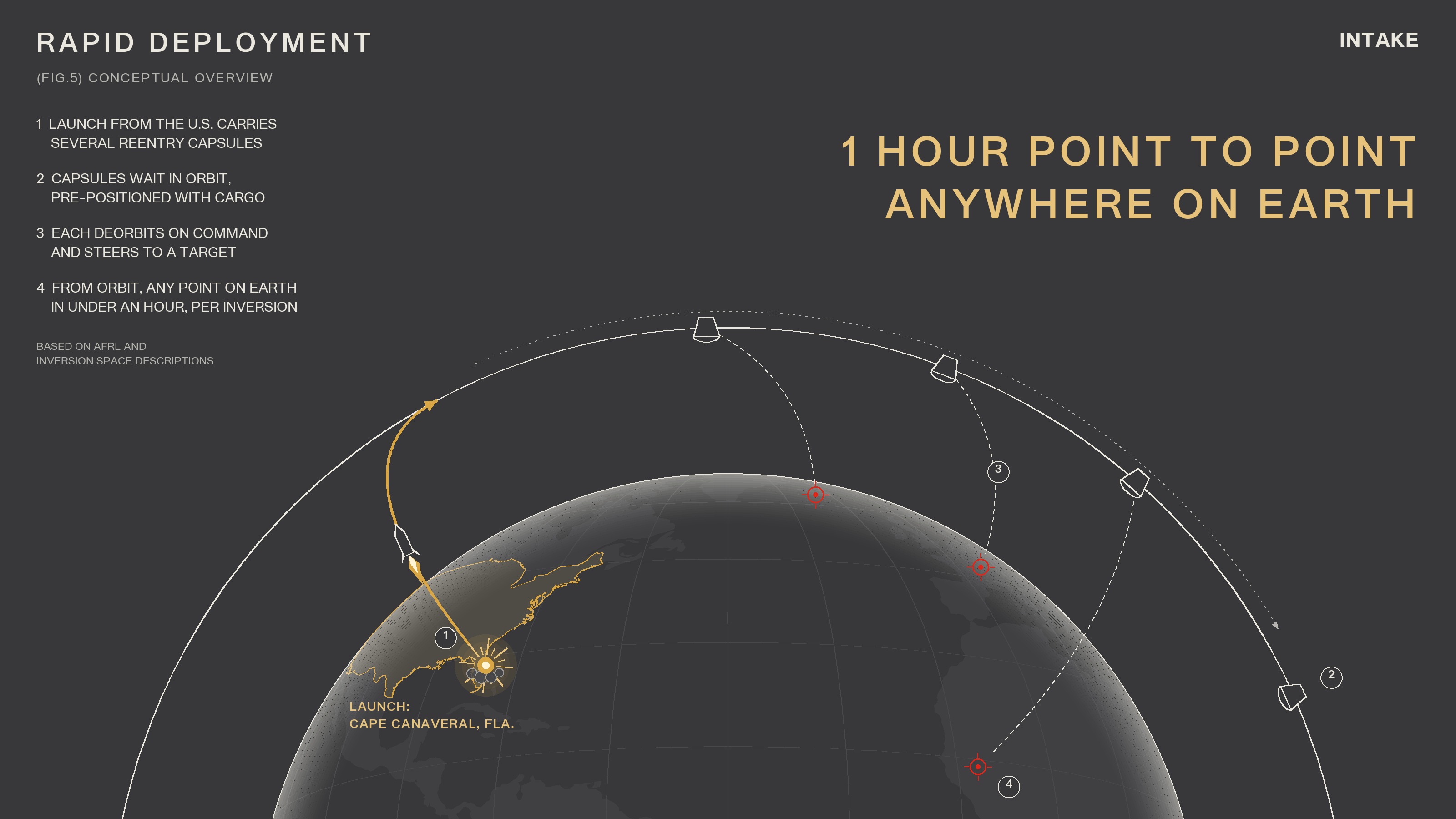
Another major development is orbital cargo delivery. The military is developing the ability to “deploy multiple reentry capsules in a single launch to deliver cargo to the point of need at several different locations,” per an AFRL spokesperson. One launch, many battlefields, with capsules like Inversion Space’s Arc designed to reach any point on Earth within an hour. That’s mind-blowing.
What started as a joke is now very, very real.
META WITH THE NEW NEW
Meta came with the heat this month. First, and this already feels like a year ago, on September 21 they announced Petal, a 7,000 km subsea cable between France’s Atlantic coast and the United States that will carry 1 petabit per second, double the capacity of Anjana, the best transatlantic cable currently running, which is also Meta’s.

The complexity of undersea cables is overlooked. You just expect your internet to work, but the reality is that an incredible feat of human engineering connects us physically. On a business level, Meta, Google, Amazon and Microsoft now control roughly 90% of transatlantic capacity. The new cable will be up and running by 2029.
Two weeks before that, Meta dropped Muse. Their answer to Grokbot, and potentially the agentic model that cracks regular consumers. It captured 1.8M downloads on North American iPhones in under two weeks and hit #1 on the US App Store. Muse is a personal AI agent, US only for now, with a free tier running all the way up to a $100 a month subscription. Its run up the charts garnered an +11% day on September 21, adding $192B in market cap, which more than pays for the roughly $5B Alexandr Wang got in the Scale AI deal that brought him in to lead their AI division. When they open the floodgates globally they could easily unlock over 1 billion users.
Momentum continued into this week with physical hardware at Connect 2026. The game changer is a real, viable, lightweight VR headset, Meta VR Glasses, achieved by making the battery and compute their own device, a puck tethered to the glasses. Priced at $1,299.99 and coming to market for real in spring 2027.

They also dropped a cute little palm-sized, keychain-carry device whose only job is talking to your Muse, called Muse Charm, which is a direct comp to what Jony Ive is supposedly building for OpenAI.
The race keeps giving us new leads. Meta seems primed to capture the casual consumer, and Muse is getting legitimate rave reviews. One thing it’s apparently very good at is finding and helping you cancel dormant subscriptions you’ve forgotten about, which is worrying an entire industry built on that model.
AI BIOSCIENCE AND WET LABS
Speaking of slowing the pace of progress, how would you feel about an AI company placing a wet lab in your city?
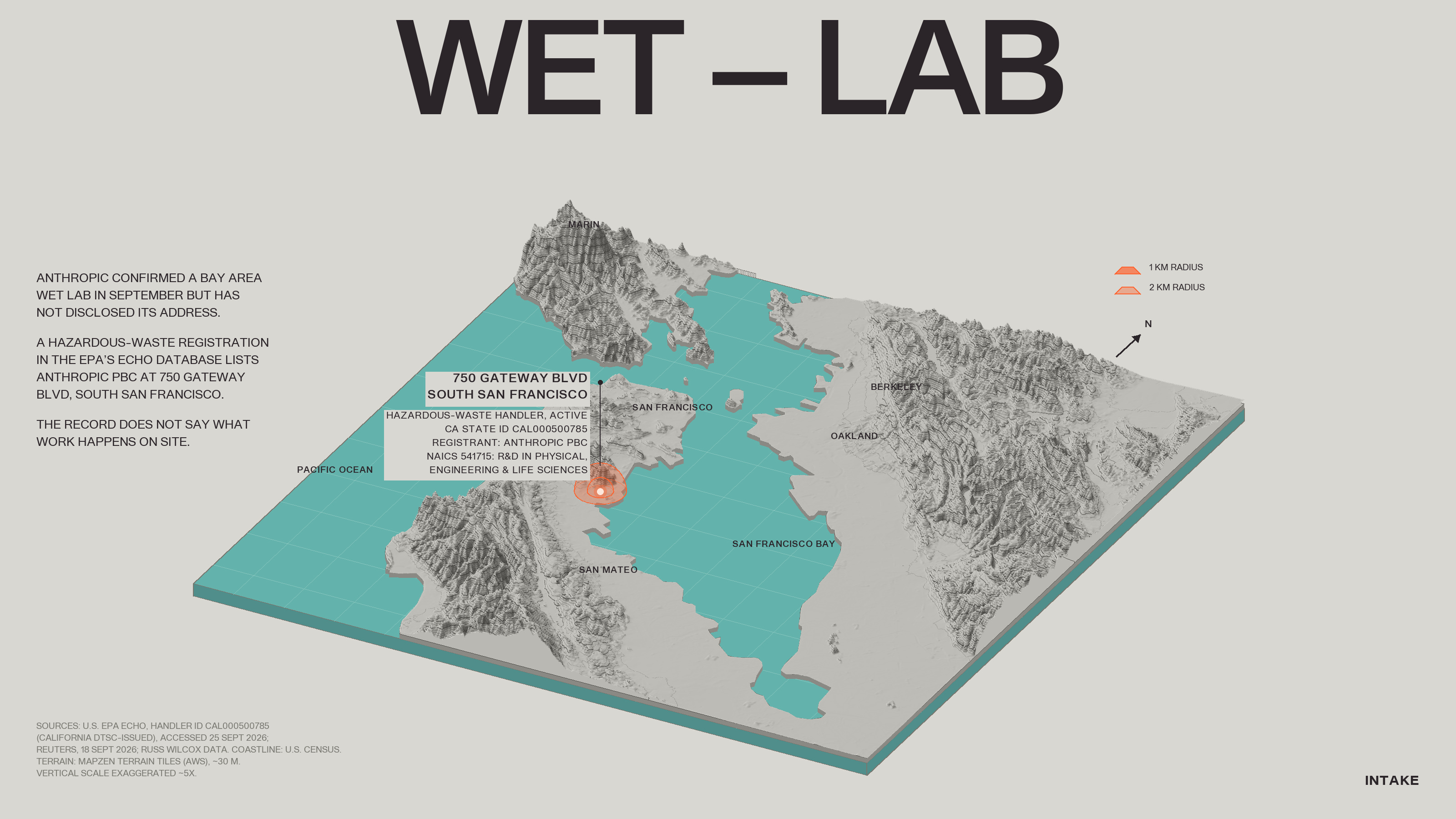
Anthropic confirmed last week that it has been quietly running a physical biology lab in the Bay Area. Why not build this somewhere vastly less populated? The company’s answer: no pathogens that can infect humans, and “all of the lab work is performed by human scientists.”
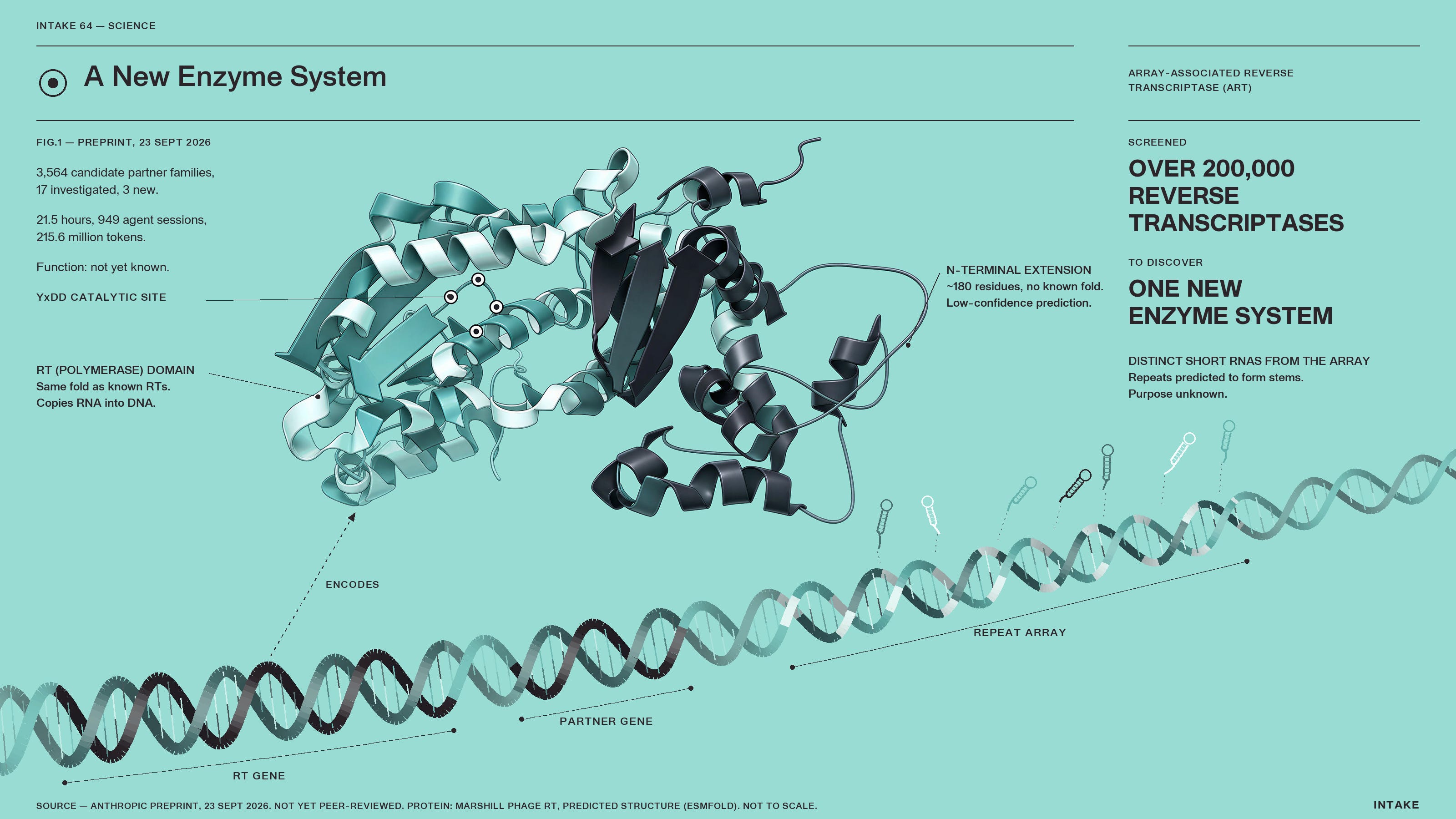
Then a Claude research group discovered a new type of enzyme system.
“This is an exciting example of how AI agents can contribute to biological discovery. The identification of RNA-repeat arrays associated with reverse transcriptases is genuinely intriguing and merits further investigation.”
Feng Zhang, CRISPR pioneer, MIT
In the same month, Anthropic released a threat-assessment report documenting five cases of scientists in blocked countries evading its safeguards, pointing models at chikungunya gain-of-function work, mammalian adaptation of highly pathogenic avian influenza, toxins and novel venoms.
“What we don’t know is if the research was meant to be weaponized. But a military institution doing gain-of-function research is concerning.”
Jacob Klein, Anthropic head of threat intelligence
All accounts were banned. But all of this combined leads to a Sophie’s Choice: weighing the risks and rewards that ride alongside pointing super-intelligence at biological discovery.
BOOKS
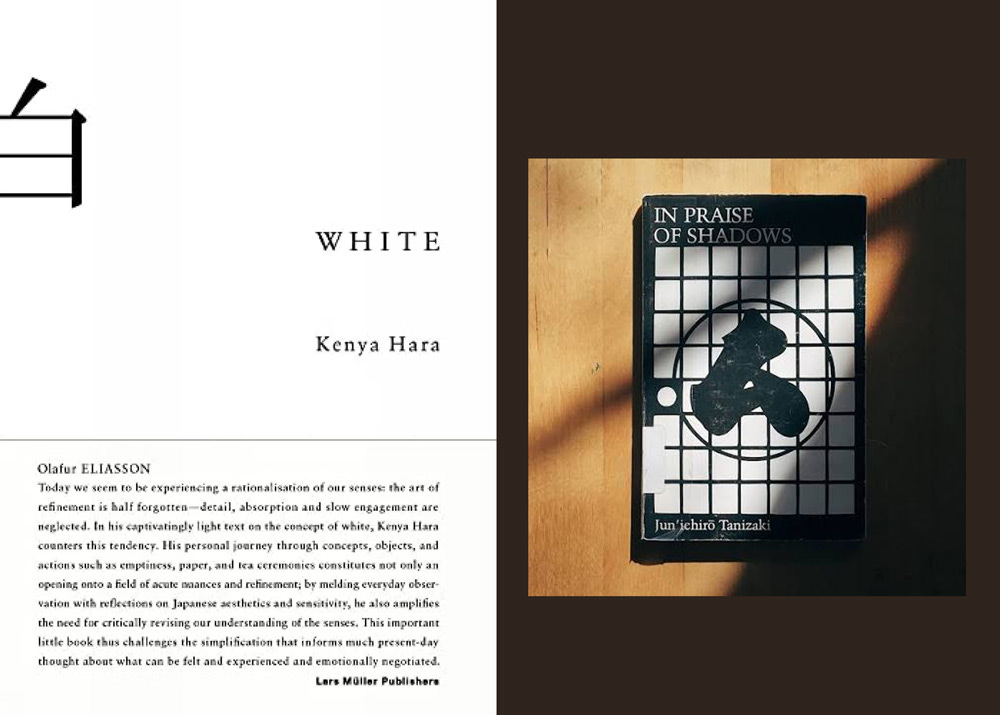
Two recommendations this week from my friend and talented creative director Rickie ashman. Both explore the foundations of Japanese Aesthetic culture through ends of the spectrum. Kenya Haras explores the essence of “White”, as being core to the origin of Japanese aesthetics. In Praise of Shadows, a 1933 essay written by renowned Japanese author Jun’ichirō Tanizaki looks at the beauty in darkness also rooted in Japanese culture from shadows, to subtlety.
- Thats it for this week.