

INTAKE #50
"Robbing them blind," a Live Nation exec said it about concert fans in Slack. Kalanick's $15B comeback, the art market's quiet recovery, and Pokemon Go's 30 billion images are now training robots.

Everything interesting this week has a longer timeline than the headline suggests.
Pokémon Go players discovered they’ve been training delivery robots with 30 billion images across nearly a decade of catching Pikachu on sidewalks. Live Nation employees have been joking about “robbing fans blind” in Slack for years, it just hit the press this week. Travis Kalanick spent five years in exile after the most public founder takedown of his generation. He’s back, doing the podcast rounds, talking about not going hard enough.
The art market is edging back after two years of decline, but the real signal is in the small galleries, not the auction houses.
MSCHF, the Brooklyn art collective that sold shares in a living cow and let the internet decide his fate, finally got their answer after 782 days. Angus lives.
This is issue 50. A year of showing up every week, which in the context of these stories feels modest. But the pattern holds whether it’s 50 issues or 30 billion images: things compound when you keep at it.
Its all about The long game.
ART BASEL UBS REPORT
“Buying is more American than thinking.”
— Warhol

After two years of decline, the Art Basel and UBS Global Art Market Report shows the global art market edging back to $59.6 billion, up 4% year over year. The coverage is cautiously optimistic, a welcome shift from two straight years of contraction.
As The Art Bystander put it:
“The market stopped flinching, but it did not start believing again.”
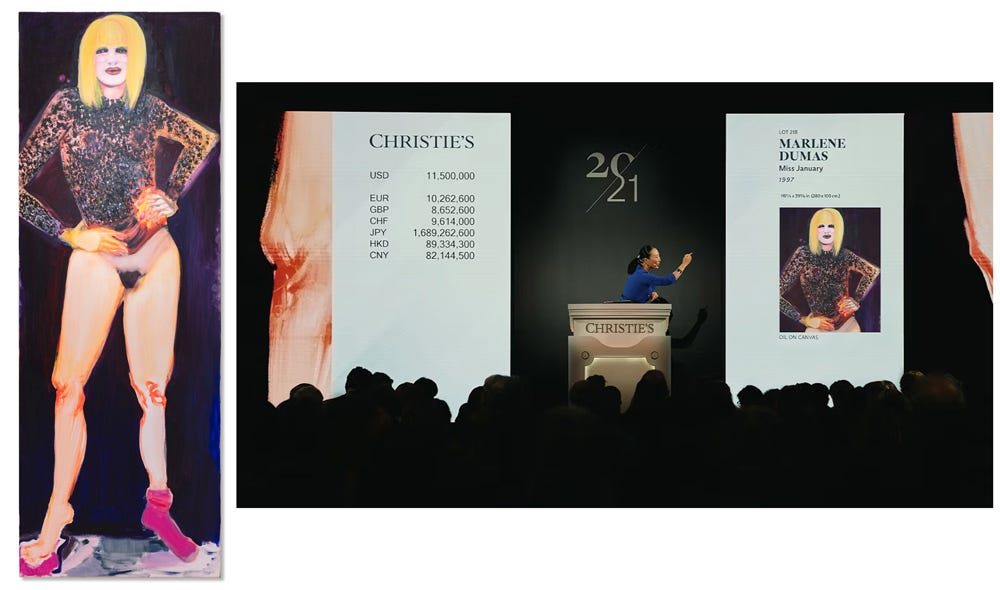
A lot of the recovery ink is about auctions. Marlene Dumas is now the highest-priced living female artist at $13.6 million, Frida Kahlo broke the women’s auction record at $54.7 million. It’s good to see living artists appreciated at scale. Female artists now make up 50% of primary market gallery rosters, parity achieved for the first time. But auctions are late-stage liquidity for art investors, an extremely niche slice of the market. Sarah Thornton documented the auction spectacle in Seven Days in the Art World. That hasn’t changed. Auctions are entertainment and liquidation events, not the only bellwether for market health.
What I find most positive isn’t at the top. It’s at the bottom. Smaller galleries with annual sales under $500K reported the strongest percentage growth of any tier. 66% of collectors bought from an artist new to them. 49% of dealer buyers were first-time buyers. Millennials and Gen Z now comprise over 50% of the buyer base, and half are buying via Instagram.

Dealers are selling more but to fewer unique buyers ( 57 per dealer, the lowest since 2021). The money is concentrating..
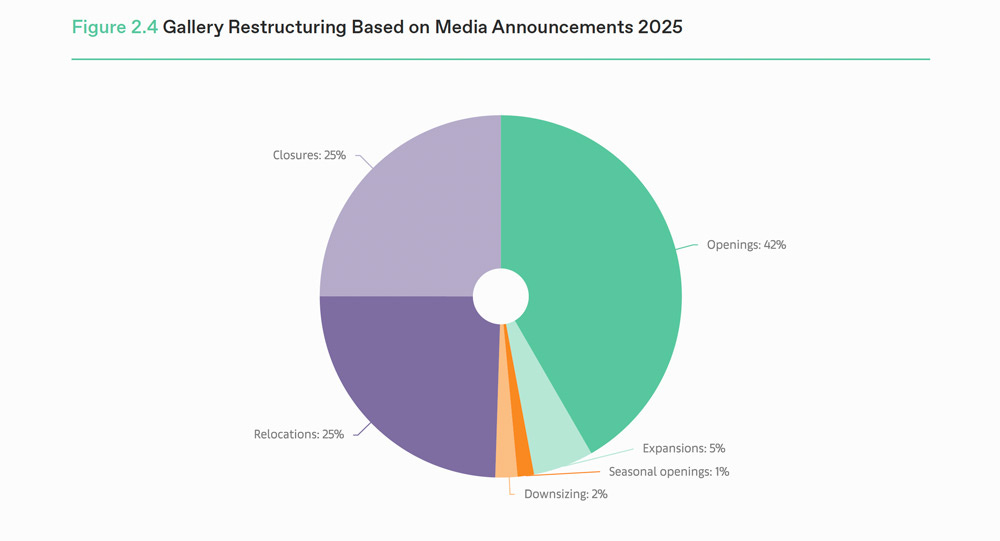
Despite the drumbeat of closure headlines last year, gallery openings (42%) outpaced closures (25%). It now feels more like legacy players bowing out, opening space for a new generation.
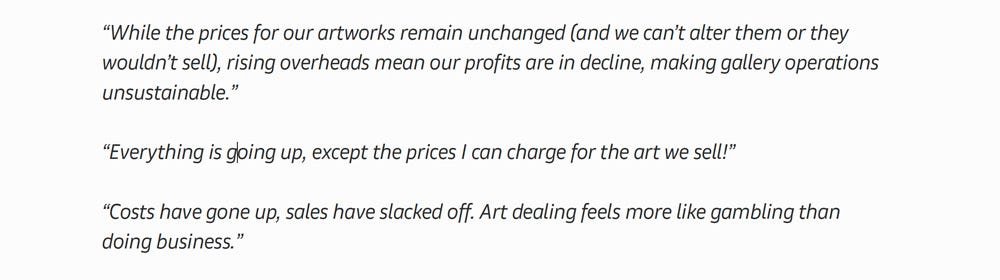
The challenge is infrastructure. Operating costs rose 5%, outpacing sales growth, and 38% of dealers reported lower profitability despite the recovery. Fairs now account for 35% of dealer revenue, an all-time high that reflects dependency more than opportunity. Galleries participate in an average of five fairs a year, not out of choice but necessity, paying $20,000+ per booth before shipping, dinners, and travel. Surveys show they fail to turn a profit at up to half the fairs they attend. The hamster wheel is expensive.
Alternative models are emerging. 7 Rue Froissart in Paris charged under $5,000 per exhibitor with free entry. Co-operative booths, revenue-share structures. The fair circuit is being quietly reimagined from the bottom up.
The art market is the epitome of the long game. Its cycles run adjacent to broader economic sentiment but never in lockstep
The most encouraging signal in this report isn’t the $59.6 billion headline. It’s that artist development is working. New galleries are opening, new collectors are discovering, and new models are replacing old ones.
‘HOME–HOME’ EXHIBITION IN JAPAN
An example of Niche counterweights to the big fairs, I love independent showcases like this. A genuine positive of our internet-driven era is that a small moment in a remote space outside Tokyo can still gain international exposure.
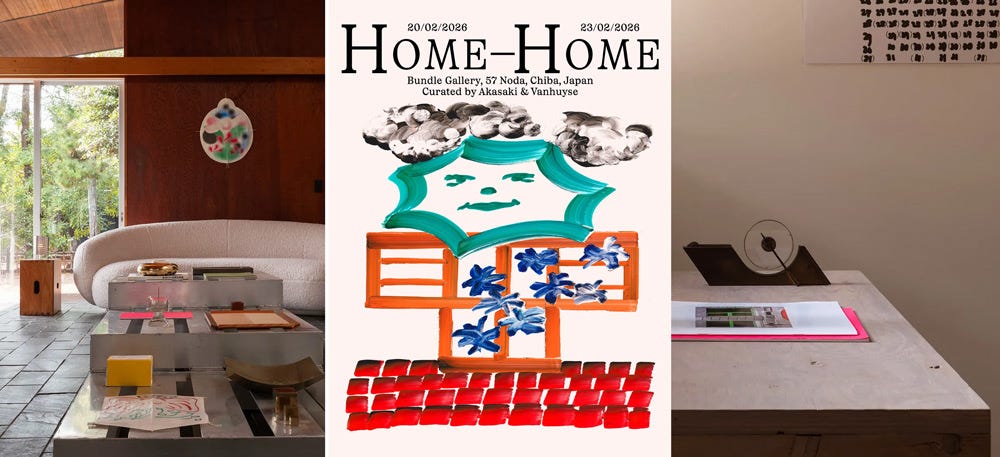
Home-Home, a 4-day exhibition curated by Brussels-based design studio Akasaki & Vanhuyse, placed work by 16 designers and artists inside a 1974 modernist house designed by Ren Suzuki, the last Japanese architect to work with Le Corbusier, in Chiba, Japan.
Everyday design objects in a rarely-opened private home, organized independently by designers rather than institutions. A refreshing counter-rhythm to the mega-fairs.
“The purpose of this show was to do something good with friends, but also to encourage more designer-led activities that happen independently and at their own pace.”
— Akasaki & Vanhuyse
A calm, digestible design setting as we roll into the bigger activations like Salone del Mobile in Milan next month. For a comprehensive round up of notable fails see Wallpaper’s design fairs shaping 2026.
THE CINEMATIC QUALITY OF DUNE
Dune’s new trailer dropped, next year is going to be epic for cinephile, with Christopher Nolan’s Odyssey and Denis Villeneuve going head to head with opus films.
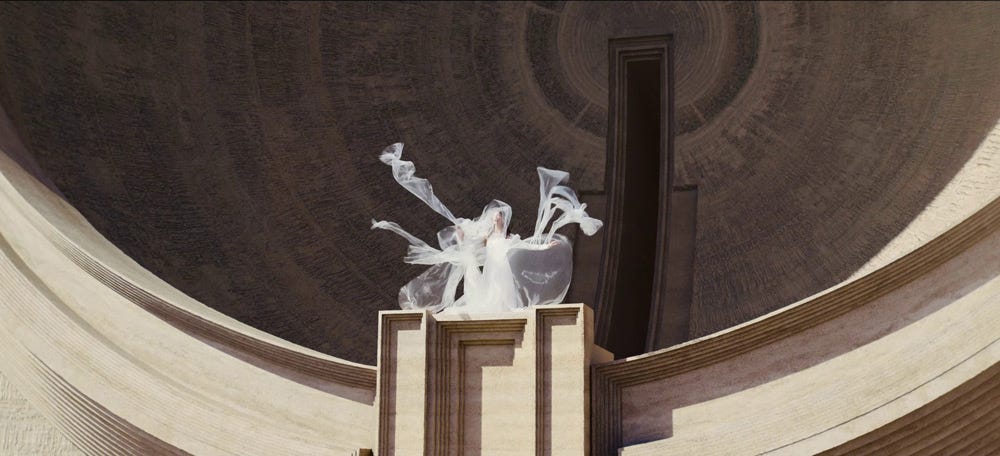
Dune 3 had super-fans concerned with Greig Fraser departing as DP, he lead the aesthetics on the first two films which in my opinion are some most powerful scenes in modern cinema (the opening of the second film is a 10/10).


From the shots in the trailer, Linus Sandgren stepped up to the plate, portraying Incomprehensible scale with jaw dropping visuals.
Take a moment to appreciate just the compositions of some of these shots.
MSCHF COW !!! LIVES
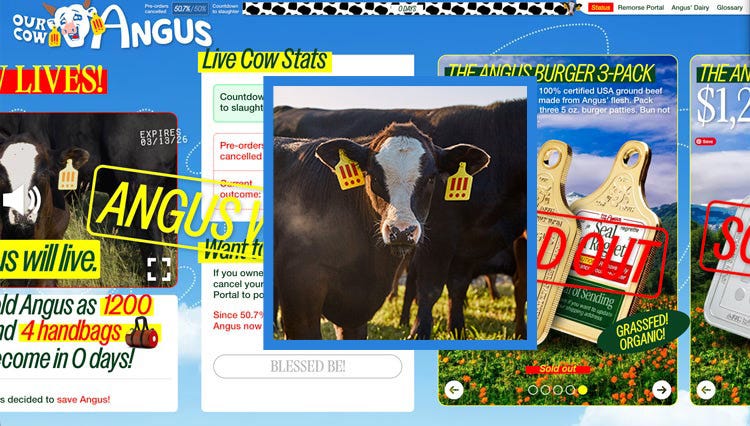
Two years ago, Brooklyn art collective MSCHF bought a black calf, pre-sold him as 1,200 hamburgers and 4 leather handbags, and built a “Remorse Portal,” a mechanism for buyers to forfeit their purchase and save the cow’s life. If 50% of the voting interest cancelled, Angus would be spared. After 782 days and a dead heat that went down to the final 10 hours, 50.7% chose cancellation. Angus will live at a sanctuary.
“I think we realized intellectually that the odds of saving him were lower than eating him because we’re asking people to proactively change their minds,”
MSCHF co-founder Kevin Wiesner told the WSJ.
“But now it’s heart-wrenching.”
The critical reception is split. ArtReview called it a “cash cow,” with only 15 website updates across 104 weeks and 2 Instagram posts about Angus versus 48 about other products. Art Newspaper said the project “failed to spark substantive dialogue,” with discourse devolving into rage-bait. Fair critiques of the execution. But they’re grading the communications strategy, not the concept.
The concept is airtight. You eat beef. Here’s a specific cow. Here’s his name. Here are his eyes. Now choose.
MSCHF has built a name for themselves with spot on commentary stunts, an ATM at Art Basel Miami that displayed your bank balance on a public leaderboard ($9.5 million topped the board). They cut up a $30,000 Damien Hirst spot painting and resold 88 individual spots at $480 each.

MSCHF’s model is the abstraction between consumer and consequence, products and moments tuned for virality. It’s led to a $200 million valuation and a creative agency arm called “Applied MSCHF” that former fans see as a sellout. The tension between cultural commentary and commercial viability is the actual MSCHF story. That story is reportedly expanding to film, with rumors of outside capital to fund a production slate and applying an A24-style model using marketing chops to push film IP into the cultural zeitgeist.
Angus will live while 899,999 other cows died the same day he was saved.
The only difference is they didn’t have a name.
NEW MUSIC: J-COLE & JAMES BLAKE
Two new albums getting heavy rotation from me right now
First, Trying Times from James Blake.
Blake’s albums pull you in, their haunting, melodic, sad, beautiful and then out of nowhere there’s a banger.
Trying times plays as beautiful background music, with ‘doesn’t just happen’ delivering on the more hype he can take it too. We’ve worked with Blake for years, initially via bookings like one of my favorite events we did with Macallan at the bass museum for Basel Miami where Blake performed with a full ballet group and we custom projection mapped the facade of the museum. Our relationship evolved into a multi year run of CMYK, an IP we co-produced bringing club nights to cities around the world adjacent to his tour, getting him back into the booth with a whole slew of cameos. Our night in London is a high note.
Second: J-cole’s “The Fall-Off”
This has been on repeat in my studio all weekend. I’ve been giving it full playthroughs’ which is rare in a single driven playlist world. It’s really growing on me. A lot of homages to classic 90’s hiphop storytelling, production slaps too.
LUXURY DESIGN - VIOLAINE ET JEREMY
While researching Belmond last week I was reintroduced to the work of Violaine et Jeremy, a Parisian design atelier I have long considered one of the best for luxury aesthetics. The work is rich, deeply leveraging hand illustration, materiality and custom typography. They now have a foundry with an extensive library of licensable fonts as well.

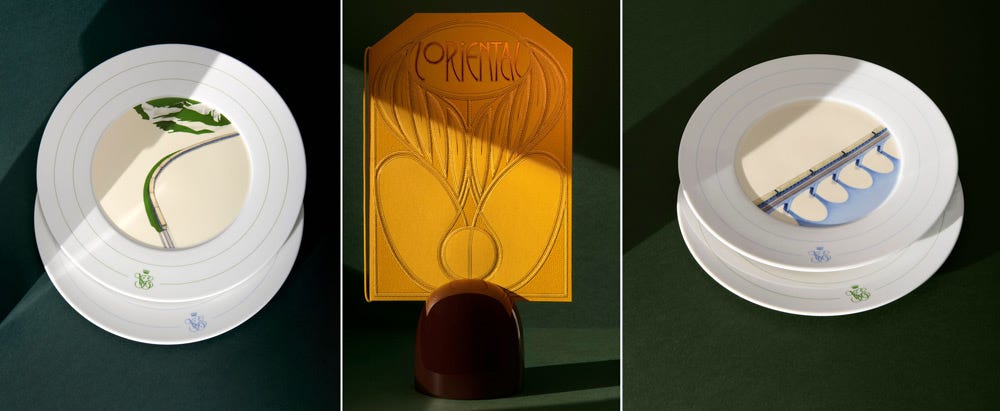
Their recent work for Belmond on Orient express lines is impeccable, the hand painted plates are worth stealing.
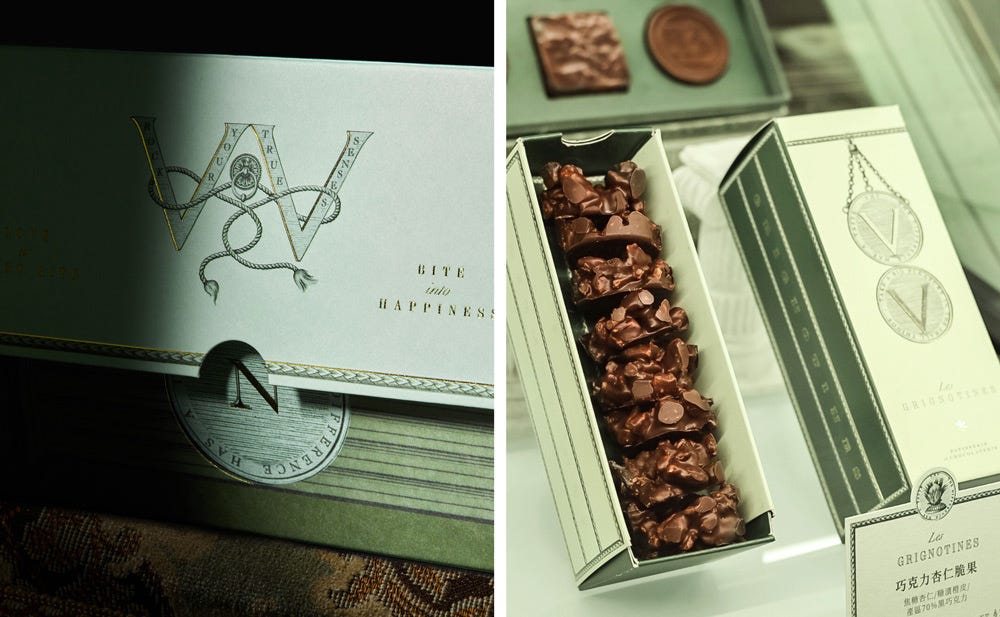
The world building for VNV pastry and chocolate shop in Taiwan is decadent
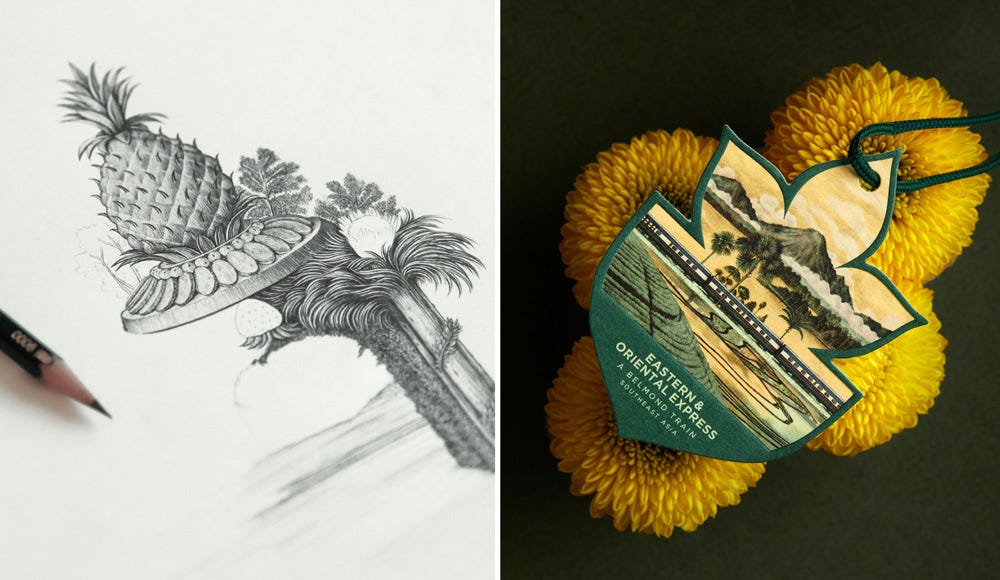
V&J’s body of work consists of the deeply crafted methodical expensive feeling projects that designers dream of.
STUDIO PRACTICE
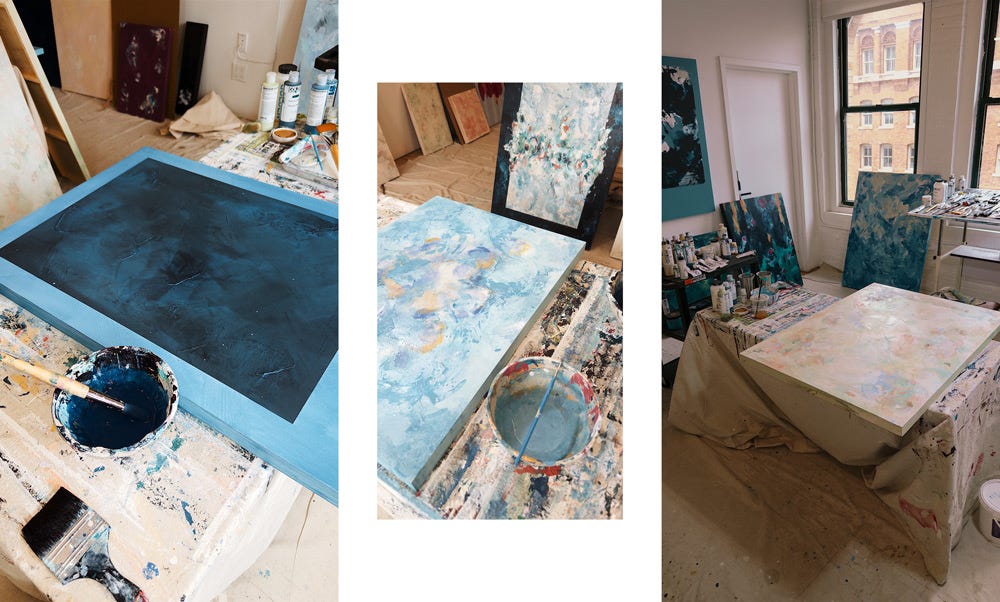
Travel disrupts a critical part of my routine which is time in studio. After a month on the road, it was refreshing to get 3 days of painting in last week. I’m working on several pieces simultaneously right now, all heavily influenced by the inbound spring.
More of my process and painting practice on my studio site.
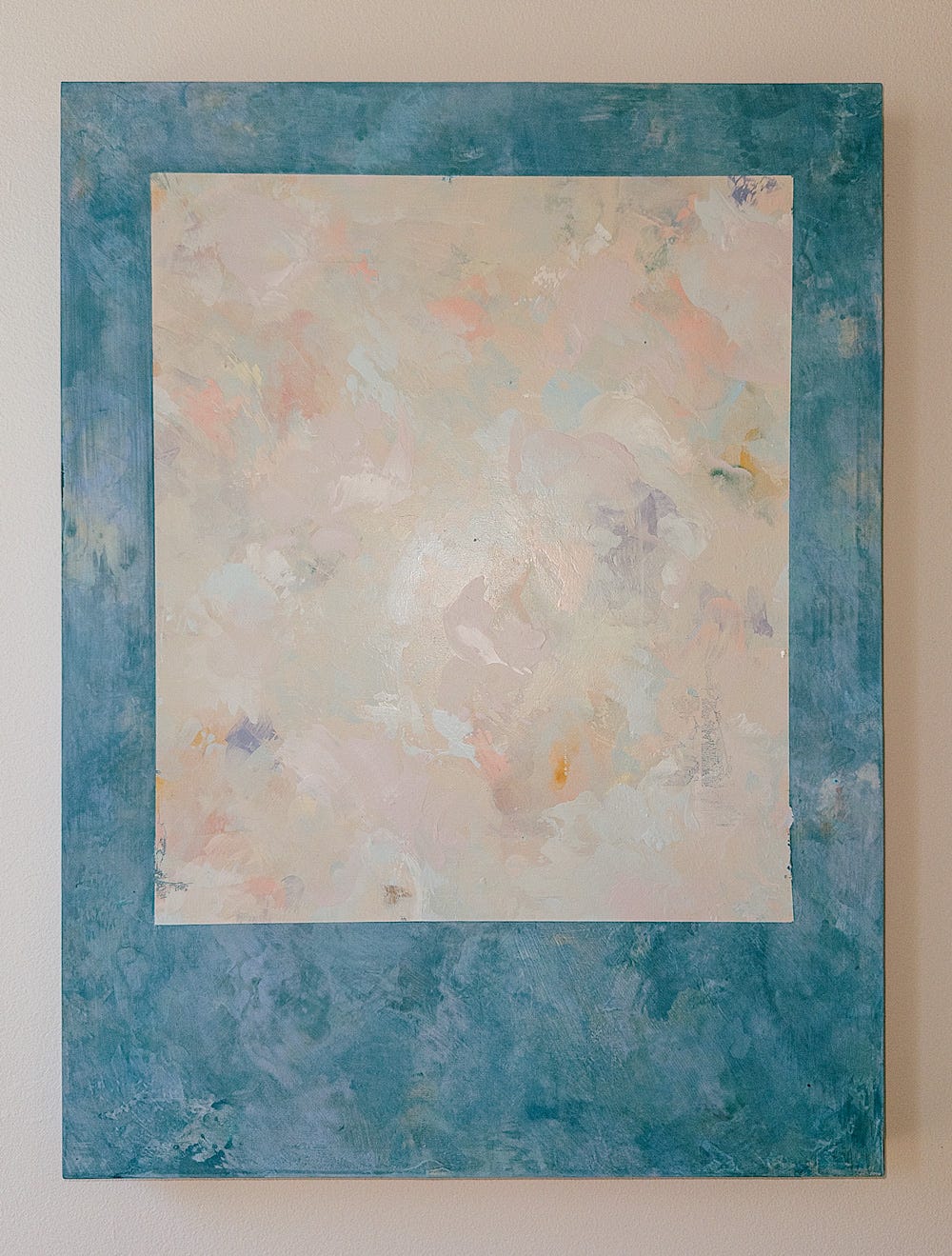
Spring Dream, #6.
Acrylic on wood.
18×24’
DRINKING DECLINE HITTING RESTAURANT REVENUE
“Young people are never going to know what it’s like to wake up at 3 in the afternoon and be like, ‘I left my credit card at the bar.’”
I had dinner with a friend last week who told me it was the first time he’d had drinks outside his wife’s birthday in three months. I’m in about the same boat, I still drink but I’ve considerably reduced how frequently, primarily because I can’t justify the hangover and its effect over the next 2-3 days. 40’s a bitch. I have a lot of friends who prefer mushroom chocolates or gummies, equally social, equally fun, no hangover.
This isn’t fringe either: only 54% of Americans now drink, the lowest rate in 90 years of Gallup polling, down from 62% just two years ago. Those who do drink average 2.8 per week, down from 4.0.
Americans are drinking less and it’s hitting the restaurant industry where it hurts most. 31% of operators reported severe alcohol sales declines in 2025. Chang called it “the real existential threat,” his restaurants are down 18% on beverage sales.
Alcohol is the financial engine of hospitality: roughly 80% margins versus 60-70% on food. A restaurant typically sees 20-25% of its total revenue from alcohol, and a disproportionate share of profit. It doesn’t spoil, it’s easier to prepare, and it’s often half the bill. Many operators build business plans around a 60/40 alcohol-to-food split, when that slides to 30/70, the math breaks (NYT).
There’s only a 25% chance Gen Z orders a drink at a restaurant versus 50% for millennials. The drivers are stacking: a generational pivot from hard partying to hard optimization. GLP-1 medications reduce alcohol cravings. Cannabis is legal for 79% of the country, the alcohol industry knew it would reduce consumption which is why they lobbied so hard against it for so long.
Hospitality has to either find ways to get people to drink again, or adapt the whole model which was based on the assumption that people want to drink. A growing number of them just... don’t.
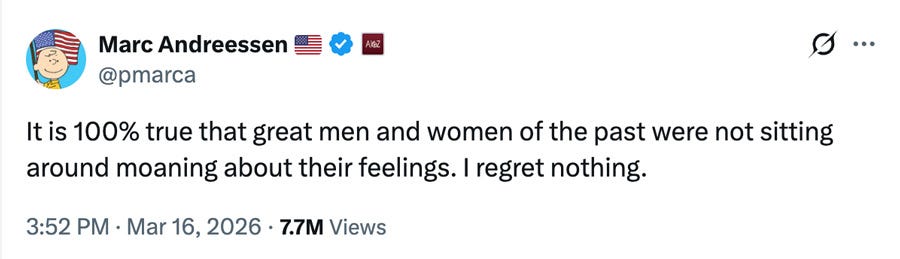
A bold and questionable statement from someone who funds hundreds of founders.
72% of entrepreneurs report mental health conditions. 30% experience depression. Sam Altman wrote about founder depression 12 years ago, the pressure to always say “we’re crushing it” when everything is falling apart. Brad Feld, co-founder of Techstars, blogged openly about a six-month depressive episode in 2013. Hundreds of entrepreneurs reached out to him privately. Many names you’d recognize. I remember reading it at the time and finding it helpful and refreshing to see someone speaking so openly about how lonely it can be.
There’s also the historical inaccuracy. Marcus Aurelius wrote the Meditations as a daily practice of self-examination. That’s not moaning. It’s considered one of the greatest works of philosophical thought, still read by millions.
Andreessen is confusing introspection with rumination. Rumination is getting stuck. Introspection is seeing clearly enough to move forward. To push a narrative of zero self-awareness from a position of enormous influence over young founders, I genuinely don’t understand what that accomplishes.
A GOOGLE UPDATE
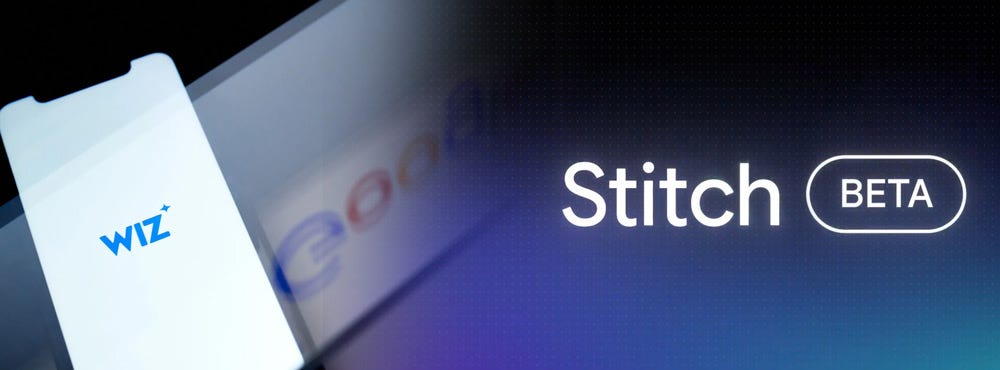
I’ve been covering Anthropic so much over the past two months as it became such a dominant force in product launches and media attention. Then Google comes with a monster week and reminds everyone who the big dog is.

In the span of ten days: the largest acquisition in company history ($32B cash for cybersecurity firm Wiz), the biggest update to Google Maps in a decade (Ask Maps, powered by Gemini, with immersive 3D navigation), a free AI design platform called Stitch that dropped Figma’s stock 11%, and 30-second unskippable ads rolling out globally on YouTube connected TVs. All at once.
The Stitch play is the one worth sitting with.
Google coined a term for it: “vibe design,” super original. You describe what you want in plain language, it generates production-quality UI, has voice editing, interactive prototypes and Exports to Figma . It’s free.
They can afford to give it away just to onboard people. It’s how the whole Google ecosystem works. When you’re planning to spend $175 to $185 billion on infrastructure this year (nearly double last year’s $91B), a design tool is customer acquisition. Figma drops 11% on the release, not because Stitch is better, but because investors understand Google doesn’t need it to be profitable.
Then, YouTube goes the other direction. Their cash cow, with $40.4B in annual ad revenue, is replacing its two 15-second ad format with single 30-second unskippable spots on your TV. Testing 60-second spots in some markets. Give with one hand, take with the other.
The Wiz numbers are staggering on their own. Four co-founders in their early 40s, each walking away with roughly $3B. A $6.4M seed investment returning $1.3B (200x). 1,800 employees splitting $4.5B in equity and retention bonuses. The largest VC-backed exit in history.
When Nancy Pelosi is exercising Google call options and selling Apple, it’s usually worth paying attention to…
But don’t sleep on Apple. They’re playing a different game entirely, more like a landlord than a builder.
Google commits $185B this year, Meta plans $115 to $135B, OpenAI has $600B in compute commitments through 2032. Apple? Only $14B. Because Apple doesn’t need to build AI, it just needs to own the device(s) that delivers it.
GenAI apps paid Apple nearly $900 million in App Store fees last year, on pace to clear $1B this year. Three-quarters of that comes from ChatGPT. The 30% App Store tax means OpenAI, Google, Anthropic, and xAI are all paying rent to Apple just to reach consumers. Add the $20B+ Google pays annually to be the default search engine in Safari, and Apple is generating more AI revenue from other people’s infrastructure than most companies generate from their own.
THE PENTAGON IS HIRING COVERAGE BANKERS.
Semafor reported that the DOD is building a 30-person “Economic Defense Unit” to deploy $200 billion over three years, recruiting directly from Goldman, JPMorgan, and Morgan Stanley.
The salary is a joke: $126K-$225K government pay vs. the $500K-$5M these bankers currently earn. But there are other draws. First, as Liz Hoffman put it on Prof G Markets, “This is a jaw-dropping amount of money and could be a very fun playground for Wall Street bankers.”
Then there’s the tax play. Under IRC Section 1043, government appointees can sell concentrated stock positions tax-free through a “certificate of divestiture,” deferring millions in capital gains. A two-year government stint doubles as a tax-efficient liquidity event.
Yahoo Finance has the headline: “The White House is Now a Hedge Fund.“ That tracks with this administration’s “art of the deal” approach, and could be the early stages of the sovereign wealth fund Trump planned with an executive order in February 2025.
Last year the government took a 9.9% stake in Intel for $8.9 billion. In January, a $1 billion direct equity stake in L3Harris, and the TikTok deal sent $10 billion to the U.S. Treasury. There is basket is a being built.
Whether governments can effectively pick winners and losers is contested. Obama’s DOE loaned $34 billion to clean-energy startups and the headlines were brutal: Solyndra ($535 million), Fisker ($529 million), and A123 Systems ($249 million) all went bankrupt and became political shorthand for government overreach. But the full portfolio turned a $30 million profit despite those losses. Tesla repaid its $465 million DOE loan nine years early.
Private money is running parallel. A16z launched a $1.2 billion American Dynamism fund backing Anduril (now raising at $60 billion), Hadrian (AI-driven precision manufacturing), and Base Power (distributed energy grid). It’s not all defense, it’s American infrastructure broadly.
Semafor’s Hoffman noted the government “probably has stakes in 12 or 15 private companies right now.” Between the $200 billion defense unit, direct equity stakes in American companies, and an inbound $10 billion brokerage fee, the sovereign wealth fund isn’t a question of if, but more what you call it.
TRAVIS KALANICK’S RETURN
“I bled, but I did not perish. I got back up and fought my way back into the arena, back to my calling. Back to building.”
Travis Kalanick went from off the grid to everywhere in the span of a week.
After eight years in stealth, building inside a company deliberately named “City Storage Systems” (the startup equivalent of putting a fake title on a blockbuster during production to avoid attention), Kalanick unveiled Atoms, a $15B robotics company spanning food automation, mining, and autonomous transport. It’s well capitalized, with $1.1 billion raised from Saudi PIF anchoring at $400 million and Kalanick injecting $150M of his own money. Employees were forbidden from listing the company on LinkedIn.
The reveal was orchestrated: TBPN, All-In Podcast alongside Michael Dell, Fortune, CNBC, and a 1,600-word manifesto. All in the same week.
Travis isn’t shying away from his trademark aggressive energy. His interview on TBPN has some strong points:
“If you’re doing something and it’s easy, it’s not valuable.”
Kalanick pulls no punches: “World class marathoner on mile 21. Is that dude smiling? No. If he is smiling, he’s about to get his ass whooped. Because somebody else who’s down for the pain will go harder and further and pass him.”
On raising capital: “If money matters, which I think we would say it does, you need to be the best in the world at it.”
Kalanick’s return puts the founder takedown era back under the microscope. TBPN’s Jordi Hays made the point that Silicon Valley has felt the void after Travis’ departure and the subsequent era of founder takedowns. An Uber investor said publicly that Uber’s new CEO Dara Khosrowshahi “lacks the ruthlessness” of Kalanick. Has Silicon Valley gotten soft as a narrative formed that aggressive founders were the problem?
Travis was the poster child for founder takedowns. Back-to-back TV series skewering him and Adam Neumann dropped the same year (WeCrashed and Super Pumped, both 2022). But it wasn’t just him: Steph Korey at Away, Ty Haney at Outdoor Voices, Audrey Gelman at The Wing. Take Outdoor Voices: Haney was forced out in 2020, the brand’s valuation collapsed from $110 million to $40 million, they closed every store by 2024, and were headed for bankruptcy before a PE firm acquired it and brought Haney back to resurrect what she built.
Coincidentally, Adam Neumann went on Rick Rubin’s Tetragrammaton last week and is bringing Workflow, his new co-working company, to market.
The founder takedown era was supposed to be corrective. Did it produce better companies, or just safer ones?
LIVE NATION SETTLEMENT BACKLASH
“Robbing them blind baby, that’s how we do.”
That’s a Live Nation regional director named Ben Baker, in a Slack message about concert fans. Live Nation called him “one junior staffer,” but he’s now Head of Ticketing for Venue Nation overseeing 150+ venues. His colleague wrote: “These people are so stupid. I almost feel bad taking advantage of them.”
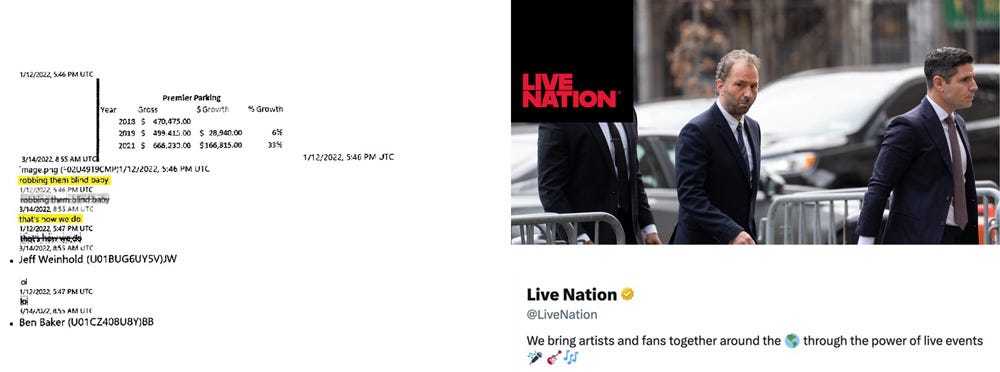
The messages were unsealed in court the same week Live Nation settled its antitrust case with the DOJ for $280 million, about 1.1% of the company’s $25.2 billion in 2025 revenue. The stock went up 6%. The settlement killed a trial that 40 state attorneys general had been building toward. 26+ of them are refusing to sign, and Baker was called as the states’ first witness this week.
“You really couldn’t send a clearer message that antitrust is dead at the federal level.”
Former antitrust official John Newman
What’s below the paywall:
What Live Nation’s settlement actually means for the concert experience. Plus Pokémon Go’s 30 billion images are now training delivery robots, a16z’s Top 100 AI consumer apps, Disney’s new CEO mic drop, and NASA’s go for launch.
This is issue 50. If you’ve been reading every week and getting value from this, a paid subscription is the best way to support the work. Many readers expense INTAKE as a professional resource, here’s a template for that.
If cost is a barrier, reply to this email, I’ll sort it out.
